
Introduction
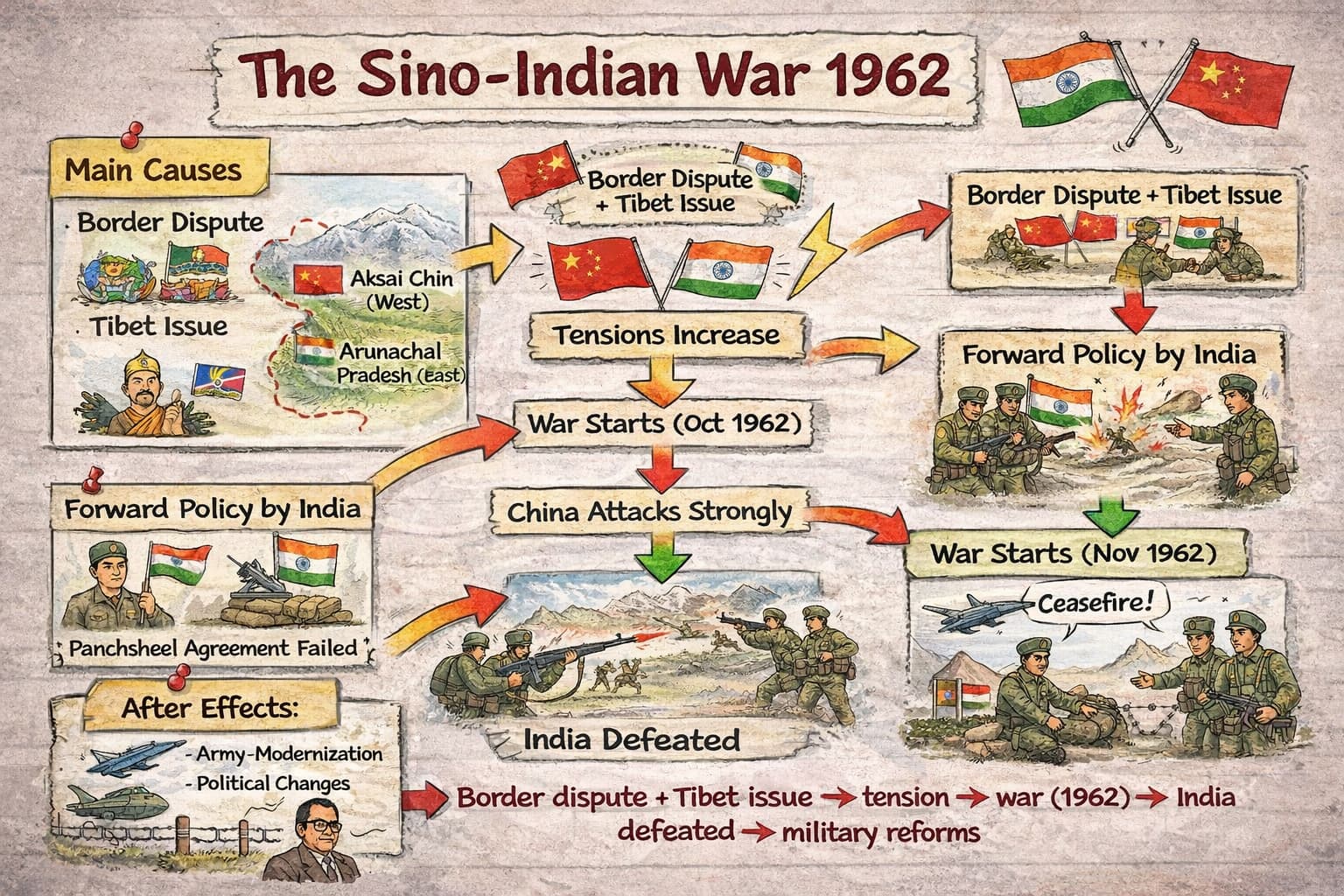
The war began on 20 October 1962. China attacked Indian positions in both sectors:
- Ladakh (Aksai Chin)
- NEFA (Arunachal Pradesh)
Indian forces were poorly prepared and lacked equipment. China advanced rapidly and captured large areas. On 21 November 1962, China declared a ceasefire and withdrew from NEFA but stayed in Aksai Chin
Causes of Sino-Indian War 1962
1. Border Dispute:-
India and China had no clear boundary on the Boarder and India accepted the McMohan Line, but it was rejected by the China. The Sino-India War was a dispute over the Aksai Chin, which was occupied by China but India Claimed that area in mine.
2. Tibet Issue:-
- China took control of Tibet in 1950.
- India gave asylum to the Dalai Lama in 1959.
- This angered China and worsened relations.
3. Forward Policy of India:-
- India set up military posts in disputed areas to stop Chinese advancement.
- China saw this as a threat.
4. Breakdown of Friendship:-
- Earlier, both countries followed the policy of Panchsheel Agreement.
- The slogan “Hindi-Chini Bhai-Bhai” failed as trust broke down.
Consequences of the Sino-India War 1962
1. Military Impact
- India realized its defence weaknesses.
- Led to modernization of the army and increased military spending.
2. Political Impact
- Major setback for Jawaharlal Nehru.
- Defence Minister V. K. Krishna Menon resigned.
3. Foreign Policy Changes
- India moved away from idealism and became more practical.
- Strengthened relations with countries like the USA and USSR.
4. Border Tensions Continue
- The dispute over Aksai Chin and Arunachal Pradesh still exists today.
- Occasional clashes continue along the border.
Summary of the Sino-India War 1962
The main reason for the Sino-Indian War was the border dispute in the Himalayan region. China claimed that Aksai Chin in Ladakh (Kashmir) and Tawang in Arunachal Pradesh belonged to it. China considered Aksai Chin as part of Xinjiang and Tawang as part of Tibet.
Aksai Chin is a cold desert located about 5000 meters above sea level. The eastern area (Arunachal Pradesh) is full of high mountains, many above 7000 meters. The war was fought in very difficult conditions, with extreme cold and tough terrain. Many soldiers died not only in battle but also because of the harsh weather.
After independence, India had friendly relations with China, and both countries shared cultural and historical ties. In 1954, both signed the Panchsheel Agreement, which promoted peaceful coexistence. India also supported China internationally.
However, relations became worse when China took control of Tibet. India suggested talks, but after the 1959 Tibetan uprising, India gave shelter to the Dalai Lama. This made China angry. China started seeing India as a threat and blamed it for the uprising. Chinese leader Mao Zedong even said that India was responsible.
In 1960, Chinese Prime Minister Zhou Enlai suggested a solution: India should give up Aksai Chin, and China would give up its claim on Arunachal Pradesh. But Jawaharlal Nehru rejected this offer, saying China had no right over these areas.
In 1962, small clashes started along the border. India followed a “Forward Policy,” sending troops to disputed areas, even beyond its borders. This increased tension.
India’s leaders believed that China would not attack, and the army was not fully prepared. Chinese forces were stronger and better prepared. Indian planning was weak.
The war lasted about one month. Around 3000 Indian soldiers were killed and about 1000 were injured. India asked for help from the USA and USSR but did not receive much support. Neither country used their air force or navy in the war.
China declared a ceasefire on 21 November 1962 after reaching its claimed areas. It also announced that its troops would move back 20 km from the Line of Actual Control.
After the war, India increased support for Tibetan refugees. The defeat also led to the resignation of Defence Minister V. K. Krishna Menon, who was blamed for poor preparation.
This war made India stronger in the long run. It improved and modernized its army and became more careful in matters of national security.
Conclusion
The Sino-Indian War was a turning point in India-China relations. It exposed India’s military weaknesses and forced a shift in foreign policy. Even today, the war’s impact is seen in ongoing border disputes and tensions between the two countries.