
Introduction:-
Economics and law are two closely related social sciences that together shape the structure and functioning of society. Economics deals with the production, distribution, and consumption of wealth and Economics is also the study or tell us about how scare resources are allocated to satisfy human wants, while law provides the rules and regulations/institution that regulate the human behaviour and economic activity. The relationship between economics and law is therefore natural and inevitable. Modern Legal System are deeply influenced by the economic principles, and economic policies require legal backing for their effective implementation. Both Economic and Law aims to achieve social welfare, social justice and balanced development of society also both wants to influence and support each other to maintain order, efficiency, and justice in society.
Relationship between Economics and Law:-
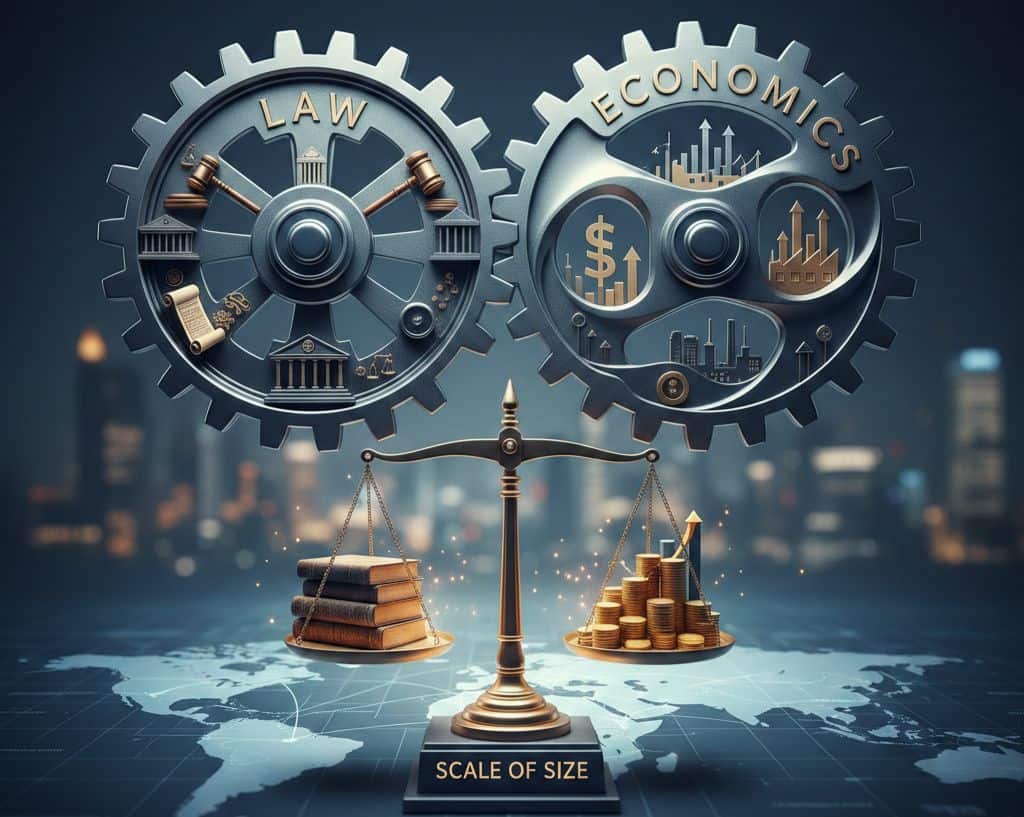
Economics serves as the foundation of law by influencing the formulation of legal rules and policies. Laws related to property, contracts, taxation, labour, and trade are based on economic principles such as efficiency, equity, and cost-benefit analysis. At the same time, law acts as an instrument of economic policy by providing enforcement mechanisms for economic decisions. Without law, economic policies would remain ineffective and unenforceable. There are so many phenomena’s in which Relationship Between Economics and Law reflected such as:
- Law Regulates a Framework for Economic Activities:- Economic activities such as trade, commerce, business, banking, and industry cannot function without legal rules. Law creates a stable and predictable environment for economic transactions.
- For example: Property laws protect ownership rights.
- Company laws regulate the formation and management of companies.
- The Indian Contract Act, 1872 ensures that agreements between parties are legally enforceable.
- Note:- Without such legal protection, there would be uncertainty and lack of trust in economic dealings.
- For example: Property laws protect ownership rights.
- Economics Influences Law-Making:- Economic objectives and conditions influence legislation such as taxation, compensation and labour laws and Economic principles also guide the legislature while making laws. Lawmakers consider economic factors like supply and demand, competition, inflation, taxation, and public welfare before framing laws.
- For example:-
- The Competition Act, 2002 was enacted to prevent monopolies and promote fair competition in markets.
- Taxation laws are framed to balance revenue collection and economic growth.
- Note:– Thus, economics helps in designing laws that promote development and efficiency.
- For example:-
- Law Regulates Distribution of Resources:- Economics deals with scarce resources. Law ensures fair distribution of these resources through law provisions
- For Example:-
- Taxation laws
- Labour laws
- Welfare legislation
- Note:- For instance, progressive taxation reduces income inequality and promotes social justice.
- For Example:-
- Economic Helps in Analysis/Interpretation of Law:- Court use economic reasoning to assess compensation, damages, and market effects. Modern legal studies include the “Economic Analysis of Law,” which examines how legal rules affect economic behavior. This theory was developed by scholars like Richard Posner.
- For example:- According to this theory:
- Laws should promote economic efficiency.
- Legal decisions should reduce social costs and maximize benefits.
- Note:- Courts sometimes consider economic consequences while interpreting laws.
- For example:- According to this theory:
- Law Controls Market Failures:- Markets may fail due to monopolies, externalities, or lack of information. Law corrects these failures through regulations.
- For example:-
- Consumer protection laws prevent unfair trade practices.
- Environmental laws control pollution.
- Competition laws prevent abuse of dominant position.
- Note:- Thus, law ensures fairness and protects public interest.
- For example:-
- Economics as a Basis of Social Welfare:- Social welfare refers to overall well being including health, education, employment and standard of living.
- Law as an Instrument of Economic Policy:- Stable legal systems attract investment, encourage entrepreneurship, and promote industrial growth. A country with strong legal institutions usually experiences better economic development. And Economic Policies are implemented through legal measures such as land reforms and financial regulations.
Scope of Relationship between Economics and Law:-
- Contracts are the backbone of economic transactions. Legal enforcement ensures trust in business activities.
- Company law regulates business organizations, mergers, and corporate governance.
- Prevents abuse of dominant position and protects market competition.
- Balances employer-employee relations and ensures fair wages and working conditions.
- Determines how revenue is collected and redistributed to promote welfare.
- Protects consumers from unfair trade practices and defective goods.
Extent of Relationship between Economics and Law:-
The term extent refers to how deeply both subjects are connected with each other.
- Law Governs Entire Economic Structure:- Almost every economic activity is regulated by law, such as: Trade and commerce, Banking and finance, Labour relations Consumer protection etc.
- Note:- For example, the Indian Contract Act, 1872 governs agreements in business transactions. Without such laws, economic dealings would lack certainty and security.
- Economics Influences Legislative Policies:– Economic principles like demand and supply, market competition, and public welfare influence law-making.
- Judicial Decisions Based on Economic Reasoning:- Courts sometimes consider economic consequences while interpreting laws. The theory of “Economic Analysis of Law,” developed by Richard Posner, explains that legal rules should promote economic efficiency and reduce social costs. This shows that economics also influences judicial interpretation.
- Law Regulates Economic Justice:– Law ensures fair distribution of resources and prevents exploitation through different law provisions such as:- Labour laws, Welfare legislation, Taxation policies etc.
Conclusion:-
In conclusion, Economics and Law are closely related disciplines. Law provides the structure within which economic activities operate, while economics helps in shaping effective and efficient laws. Together, they ensure economic growth, stability, and social justice.