Introduction:
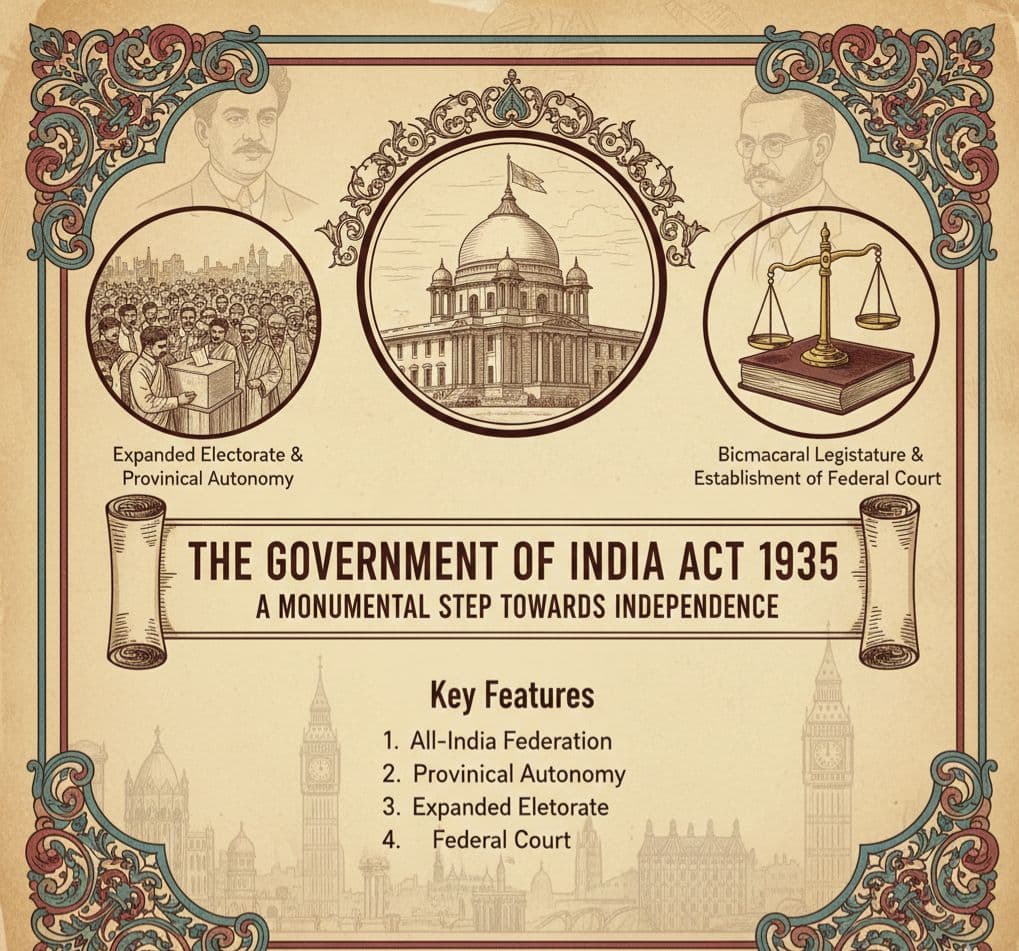
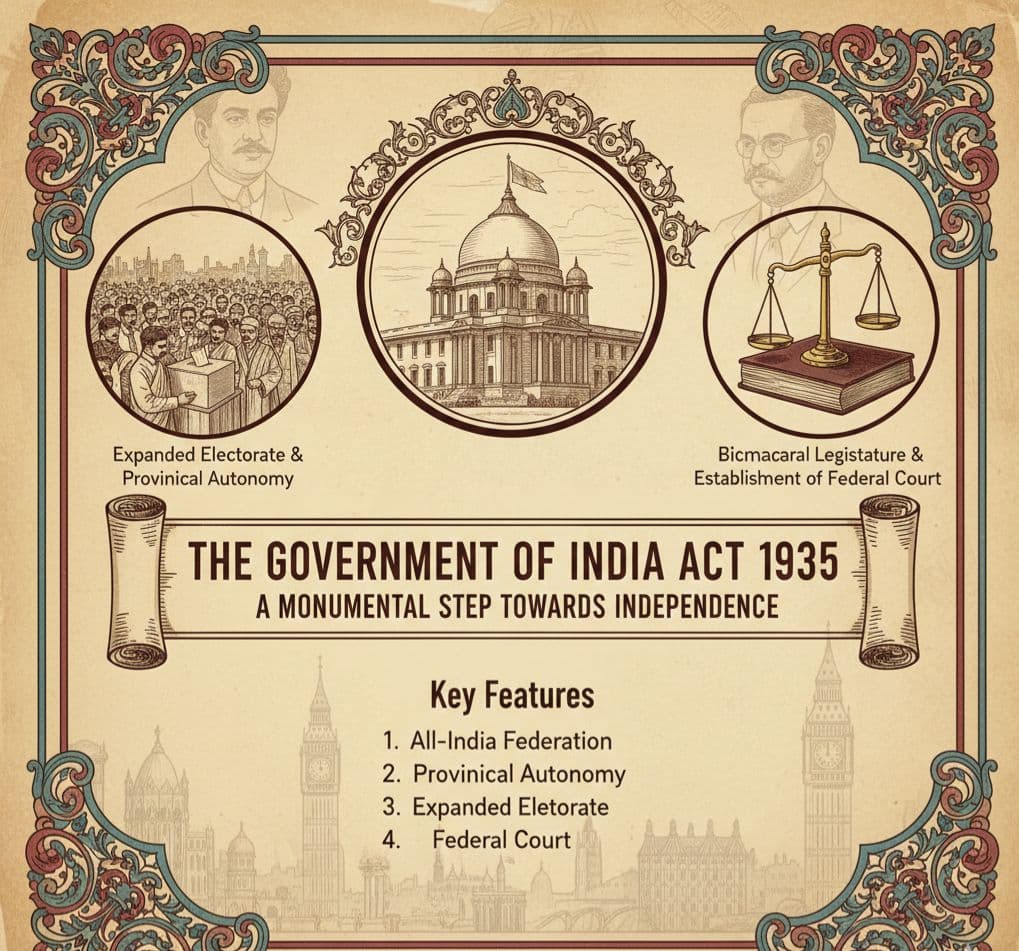
The Government of India Act, 1935 was the most comprehensive and important constitutional reform introduced by the British Government in India before independence. It was a landmark legislation passed by the British Parliament to expand the governance of British India that came into effect on April 1, 1937. The Government of India Act 1935 was one of the most important legislative measures enacted by the British Parliament to govern British India. The Act marked a significant shift towards Indian self-government. It proposed a federal structure, granted provincial autonomy, and expanded the electoral base in response to growing demands for increased Indian participation in governance.
Despite its limitations and the British’s continuing dominance, the Act laid the groundwork for India’s constitutional development and eventual independence in 1947.
Background of the Government Act 1935
Several political events and demands for greater autonomy in India influenced the Government of India Act of 1935.
- Montagu-Chelmsford Reforms (1919): It introduced dyarchy in provinces, giving elected Indian ministers control over certain areas. However, they fell short of self-government demands.
- Simon Commission(1927): The commission was formed to review the 1919 reforms and it faced protests for excluding Indians. Its 1930 report suggested major constitutional changes.
- Round Table Conferences (1930-1932): It was held in London, these meetings exposed divisions among Indian leaders and emphasised the need for broader reforms.
- Communal Award (1932): Proposed separate electorates for religious communities, complicating the constitutional landscape.
White Paper (1933): It laid the basis for the Government of India Act 1935
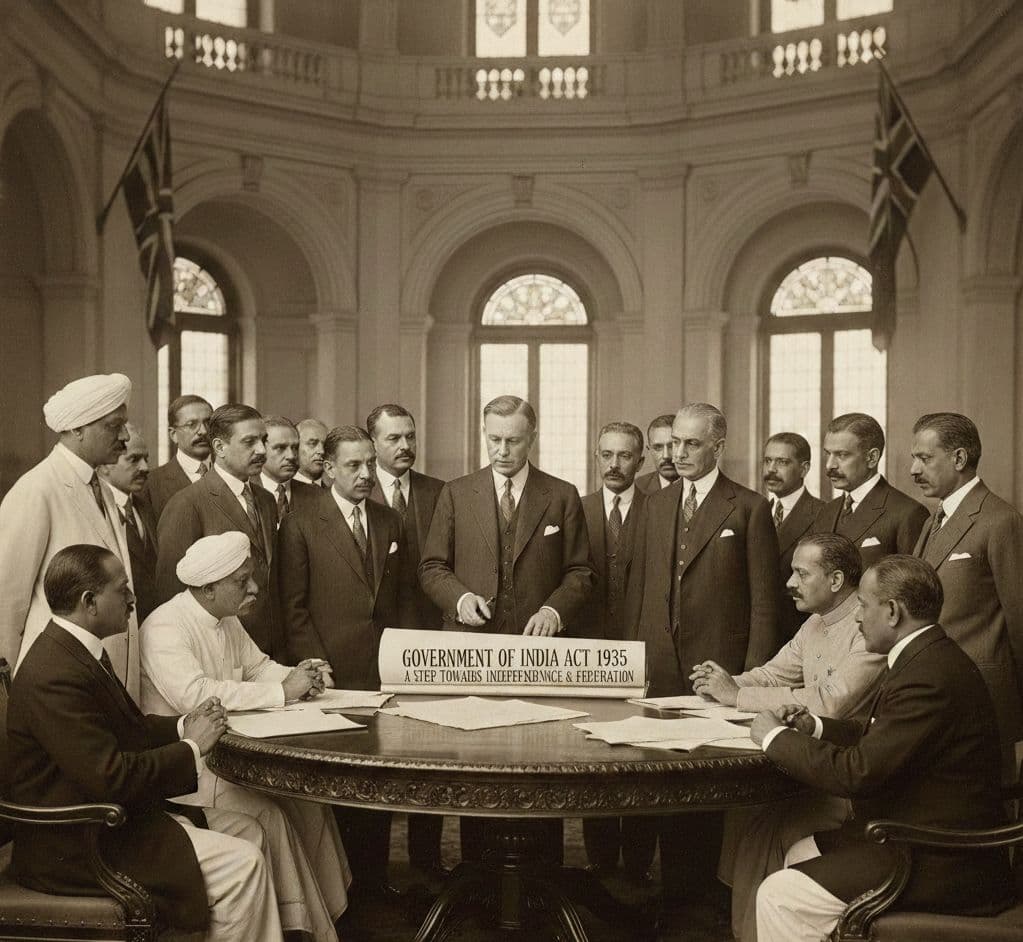
Provisions of the Government Act 1935 are:
The Government of India Act of 1935 established an All-India Federation, provincial autonomy, and bicameral legislatures, which increased local power. Despite these changes, the central government remained under British control, and the Act was enforced in April 1937.
The key provisions that reshaped the constitutional framework of British India are:
- Expansion of Franchise: Voting rights were extended to approximately 30 million people or roughly 10% of the population.
The extension was based on criteria such as property, education, and income, which significantly increased the electorate compared to previous reforms. - All-India Federation: It proposed the establishment of an All-India Federation.
- The federation was to include:
- British Indian Provinces
- Princely States
- However, this federation never came into force because the princely states did not join.
- Provincial Autonomy: The Act introduced Provincial Autonomy.
- Provinces were given independent powers.
- The system of Dyarchy in Provinces (introduced by the Government of India Act 1919) was abolished.
- Ministers were made responsible to the provincial legislatures.
- Bicameral Legislature: It established a bicameral legislature at the provincial level in some provinces (Madras, Bombay, Bengal, United Provinces, Bihar, and Assam), consisting of a Legislative Assembly and a Legislative Council.
- Division of Powers: The Government of India Act of 1935 divided powers between central and provincial governments into three lists:
- Federal List: Exclusively under central government control, covering defence, foreign affairs, and communications.
- Provincial List: Solely under provincial jurisdiction, including police, public health, and agriculture.
- Concurrent List: Shared authority between central and provincial governments, covering subjects like criminal law and marriage.
- The Viceroy retained control over unspecified subjects to protect British interests, but the proposed federation failed as many princely states refused to join.
- Federal Court: It provided for the establishment of a Federal Court, which was established in 1937. Nonetheless, the Privy Council in London remained the final court of appeal.
- Communal Representation: The system of separate electorates was expanded to include not only Muslims, but also depressed classes (scheduled castes), women, and labour (workers), thereby expanding communal representation.
- Retention of British Control: Despite increased provincial autonomy, the British Crown maintained control, with the Governor-General and Governors exercising discretionary authority in defence, foreign affairs, and security.
- Establishment of Public Service Commissions: A Federal Public Service Commission, Provincial Public Service Commissions, and Joint Public Service Commissions were formed to oversee civil service recruitment and administration.
- Abolition of the Council of India: The Council of India, established under the Government of India Act of 1858, was abolished and replaced by a team of advisors for the Secretary of State for India, thereby centralising administrative control.
- Provisions for Joint Sittings: Joint Sittings of the bicameral legislatures are permitted in the event of a legislative deadlock, as a means of resolving conflicts between the two houses.
Government of India Act 1935 Reactions
The Government of India Act of 1935 received mixed reactions but the Act ultimately failed to satisfy Indian demands, pushing the nationalist movement closer to the goal of full independence by 1947:
- Indian National Congress (INC)(1885): The INC criticized the Act for not granting full independence, opposing the limited provincial autonomy and continuing British control over key areas like defence and foreign affairs. They viewed it as a flawed step, falling short of India’s aspirations for self-rule.
- Muslim League(1966): While the Muslim League also wanted more significant reforms, they saw the Act as a step toward securing political representation for Muslims through separate electorates and reserved seats.
- Princely States: The princely states resisted joining the proposed federal structure, as they feared losing autonomy to the central government.
- British Government: The British saw the Act as a necessary compromise to maintain control while addressing growing Indian political demands. However, the Act’s limitations led to intensified calls for complete independence
Merits of the Government Act 1935
- Introduced Provincial Autonomy
- Expanded franchise (about 10% of population got voting rights)
- Established Federal Court
- Laid foundation for federal structure in India
Demerits of the Government Act 1935
- Federation never came into force
- Governor-General had excessive powers
- Separate electorates increased communalism
- No real responsible government at the Centre
Conclusion:
The Government of India Act, 1935 was a significant step toward self-government in India, but it still kept ultimate power in British hands. Though not fully successful, it laid the foundation for the future constitutional development of India.