
Introduction
Judicial review of administrative action is the important part or features of the Indian Constitution. It serves as a mechanism to ensure that administrative authorities exercise their powers within the limits of the law. If such actions are illegal, arbitrary, or unconstitutional, the courts can declare them invalid. It means the power of the judiciary to examine the legality and constitutionality of actions of the executive and legislature. The Supreme Court and High Courts exercise judicial review mainly through writ jurisdiction under:
- Article 32 – Power of the Supreme Court of India (The Supreme Court to issue writs for the enforcement of fundamental rights and to remedy any violation of legal rights.)
- Dr. B.R. Ambedkar called it the “heart and soul” of the Constitution.
- Article 226 – Power of the High Courts of India (It empowers the High Courts to issue writs for the enforcement of fundamental rights and to remedy any violation of legal rights.)
- High Courts can issue writs against any authority within their territorial jurisdiction
Judicial review ensures that administrative authorities act within the limits of law and do not violate Fundamental Rights or other legal rights.
Meaning Of Judicial Review of Administrative Action In India.
1. Judicial Review:-
It has been recognized as a necessary and basic requirement for the construction of an advanced civilization to safeguard the liberty and rights of the citizens. The power of judicial review in India is significantly vested upon the High Courts and the Supreme Court of India. Judicial review is the court’s power to review the actions of other branches of government, especially the court’s power to deem invalid actions exercised by the legislative and executive as ‘unconstitutional’.
Judicial Review Deals with,
- Judicial Review of Legislative Action.
- Judicial Review of Administrative Action.
- Judicial Review of Judicial Action (Lower Courts).
2. Grounds of Judicial Review of Administrative Action in India
The grounds for judicial review of administrative action in India are primarily based on the principles of natural justice, reasonableness, non-arbitrariness, and the violation of fundamental rights. Some common grounds include:
- Procedural Impropriety: This refers to instances where an administrative authority fails to follow the prescribed procedures or acts in a biased manner during decision-making.
- Irrationality and Unreasonableness: The courts assess whether the decision is based on rational grounds and whether a reasonable person would have reached the same conclusion.
- Illegality: Judicial review is exercised when an administrative action exceeds the authority granted by law or contravenes statutory provisions.
- Proportionality: The court examines whether the administrative action is proportionate to the objective it seeks to achieve and whether it infringes on fundamental rights.
Modes of Judicial Review of Administrative Action
There are two primary modes of judicial review of administrative action in India:
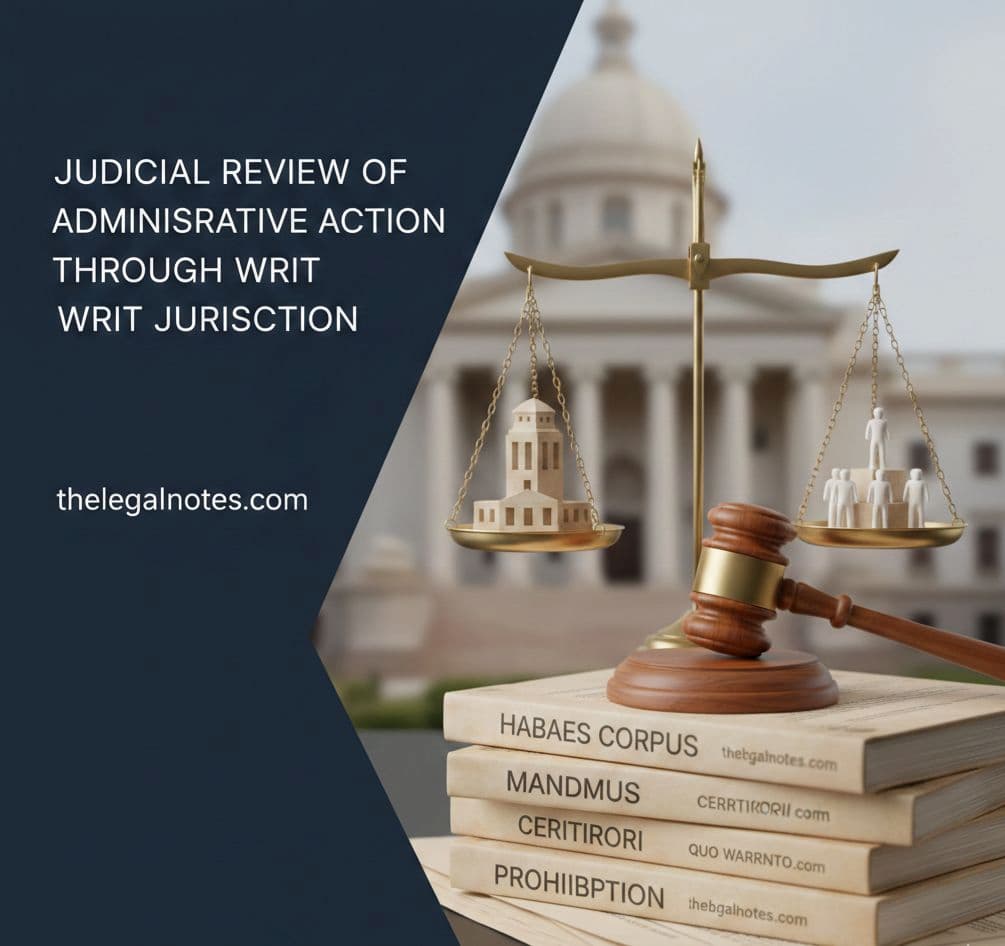
- Writ Jurisdiction: The High Courts and the Supreme Court have the authority to issue writs. It includes writs of certiorari, mandamus, prohibition, habeas corpus, and quo warranto to rectify errors and enforce fundamental rights.
- Statutory Appeals: Various statutes provide for appeals to higher courts against administrative decisions. These appeals serve as a mechanism for reviewing administrative action, particularly in specialized areas such as Tax, Environment, and Labour laws.
What is Writs in the Indian Constitution?
Writs are a written order from the Supreme Court or High Court that commands constitutional remedies for Indian Citizens against the violation of their fundamental rights. Article 32 in the Indian Constitution deals with constitutional remedies that an Indian citizen can seek from the Supreme Court of India against the violation of his/her fundamental rights. The same article gives the Supreme Court power to issue writs for the enforcement of rights whereas the High Court has the same power under Article 226.
Types of Writs
- Habeas Corpus
- Mandamus
- Prohibition
- Certiorari
- Quo-Warranto
1. Habeas Corpus:- ‘To Have the Body of.’
The Latin meaning of the word ‘Habeas Corpus’ is ‘To have the body of.’ This writ is used to enforce the fundamental right of individual liberty against unlawful detention. Through Habeas Corpus, Supreme Court/High Court orders one person who has arrested another person to bring the body of the latter before the court. If the Court concludes that the detention was unlawful, then it directs the person to be released immediately.
- Facts about Habeas Corpus in India: The Supreme Court or High Court can issue this writ against both private and public authorities.
- Circumstances of unlawful detention are:
- The detention was not done in accordance with the procedure laid down. For instance, the person was not produced before a Magistrate within 24 hours of his arrest.
- The person was arrested when he did not violate any law.
- An arrest was made under a law that is unconstitutional.
- Habeas Corpus can not be issued in the following cases:
- When detention is lawful
- When the proceeding is for contempt of a legislature or a court
- Detention is by a competent court
- Detention is outside the jurisdiction of the court
- Case:- In Sunil Batra v. Delhi Administration (1980 AIR 1579) case, an application was made to the Supreme Court through a letter written by a co-convict on the maltreatment of the prisoners. This letter was taken up by the Supreme Court and it issued the writ of habeas corpus stating that this writ can not only be used against illegal arrest of the prisoner but also for his protection against any maltreatment or inhuman behaviour by the detaining authorities.
2. Mandamus:- ‘We command’.
This writ is used by the court to order the public official who has failed to perform his duty or refused to do his duty, to resume his work. Besides public officials, Mandamus can be issued against any public body, a corporation, an inferior court, a tribunal, or government for the same purpose.
Facts about Mandamus in India:
- Unlike Habeas Corpus, Mandamus cannot be issued against a private individual
- Mandamus can not be issued in the following cases:
- To enforce departmental instruction that does not possess statutory force
- To order someone to work when the kind of work is discretionary and not mandatory
- To enforce a contractual obligation
- Mandamus can’t be issued against the Indian President or State Governors
- Against the Chief Justice of a High Court acting in a judicial capacity
- Case:- Suganmal v. State of M.P. (AIR 1965 SC 1740) case, the petitioner (person who files the writ petition) filed for issuing a writ of mandamus to direct the respondent (opposite party in the writ) for refunding tax. The Supreme Court held that where an assessment order was set aside and the rules concerned did not provide for refund of tax levied, a writ of mandamus cannot be issued. The proper remedy is filing a suit for claiming the refund.
3. Certiorari:- ‘To be certified’ or ‘To be informed.’
The meaning of the writ of ‘Certiorari’ is ‘To be certified’ or ‘To be informed.’ This writ is issued by a court higher in authority to a lower court or tribunal ordering them either to transfer a case pending with them to itself or quash their order in a case. It is issued on the grounds of an excess of jurisdiction or lack of jurisdiction or error of law. It not only prevents but also cures for the mistakes in the judiciary.
Certiorari’ means to ‘certify’. Certiorari is a curative writ. When the Court is of the opinion that a lower court or a tribunal has passed an order which is beyond its powers or committed an error of law then, through the writ of certiorari, it may transfer the case to itself or quash the order passed by the lower court or tribunal.
Facts about Certiorari in India:
- Pre-1991: The writ of Certiorari used to be issued only against judicial and quasi-judicial authorities and not against administrative authorities
- Post-1991: The Supreme Court ruled that the certiorari can be issued even against administrative authorities affecting the rights of individuals
- It cannot be issued against legislative bodies and private individuals or bodies
4. Prohibition:-
A writ of prohibition is issued by a Court to prohibit the lower courts, tribunals and other quasi-judicial authorities from doing something beyond their authority. It is issued to direct inactivity and thus differs from mandamus which directs activity.
It is issued when the lower court or tribunal acts without or in excess of jurisdiction or in violation of rules of natural justice or in contravention of Fundamental Rights. It can also be issued when a lower court or tribunal acts under a law that is itself ultra vires.
5. Quo-Warranto:- ‘By what authority or warrant.’
The literal meaning of the writ of ‘Quo-Warranto’ is ‘By what authority or warrant.’ Supreme Court or High Court issue this writ to prevent illegal usurpation of a public office by a person. Through this writ, the court enquires into the legality of a claim of a person to a public office.
Quo Warranto’ means ‘by what warrant’. Through this writ, the Court calls upon a person holding a public office to show under what authority he holds that office. If it is found that the person is not entitled to hold that office, he may be ousted from it. Its objective is to prevent a person from holding an office he is not entitled to, therefore preventing usurpation of any public office. It cannot be issued with respect to a private office.
Facts about Quo-Warranto in India:
- Quo-Warranto can be issued only when the substantive public office of a permanent character created by a statute or by the Constitution is involved t can’t be issued against private or ministerial office
- The nature of duties arising from the office must be public.
- The public office is wrongfully assumed by the private person.
- The office was created by the constitution or law and the person holding the office is not qualified to hold the office under the constitution or law.
- The term of the public office must be of a permanent nature
Note: This writ gives the right to seek redressal to any individual other than the aggrieved person.
Case:- Jamalpur Arya Samaj Sabha v. Dr D Rama (AIR 1954 Pat. 297) case, the petitioner filed an application for issuing the writ of Quo Warranto against the Working Committee of Bihar Raj Arya Samaj Pratinidhi Sabha, which was a private body. The High Court of Patna refused to issue the writ of Quo Warranto because it was not a public office.
Importance of Writ Jurisdiction in Administrative Law
- Protects Fundamental Rights.
- Ensures Rule of Law.
- Controls abuse of administrative power.
- Maintains separation of powers.
- Strengthens democracy.
Without judicial review, administrative authorities may act arbitrarily.
Limitations of Judicial Review are:-
- Courts do not interfere in policy matters.
- No interference in purely administrative discretion unless abused.
- Alternative remedy rule (generally writ not issued if other remedy available).
- Cannot review legislative action under writ except on constitutional grounds.
Conclusion
Judicial review through writ jurisdiction is a powerful weapon in the hands of the judiciary to control administrative authorities. Articles 32 and 226 of the Constitution empower the Supreme Court and High Courts to issue writs for protecting rights and ensuring legality of administrative actions.
Thus, judicial review of administrative action through writ jurisdiction acts as a guardian of Fundamental Rights and a check on arbitrary exercise of power in India.