
Introduction
It is a system that continue the features of both capitalist and socialist economics, where private and public sector co exist, and the government paly a regulatory and welfare role.
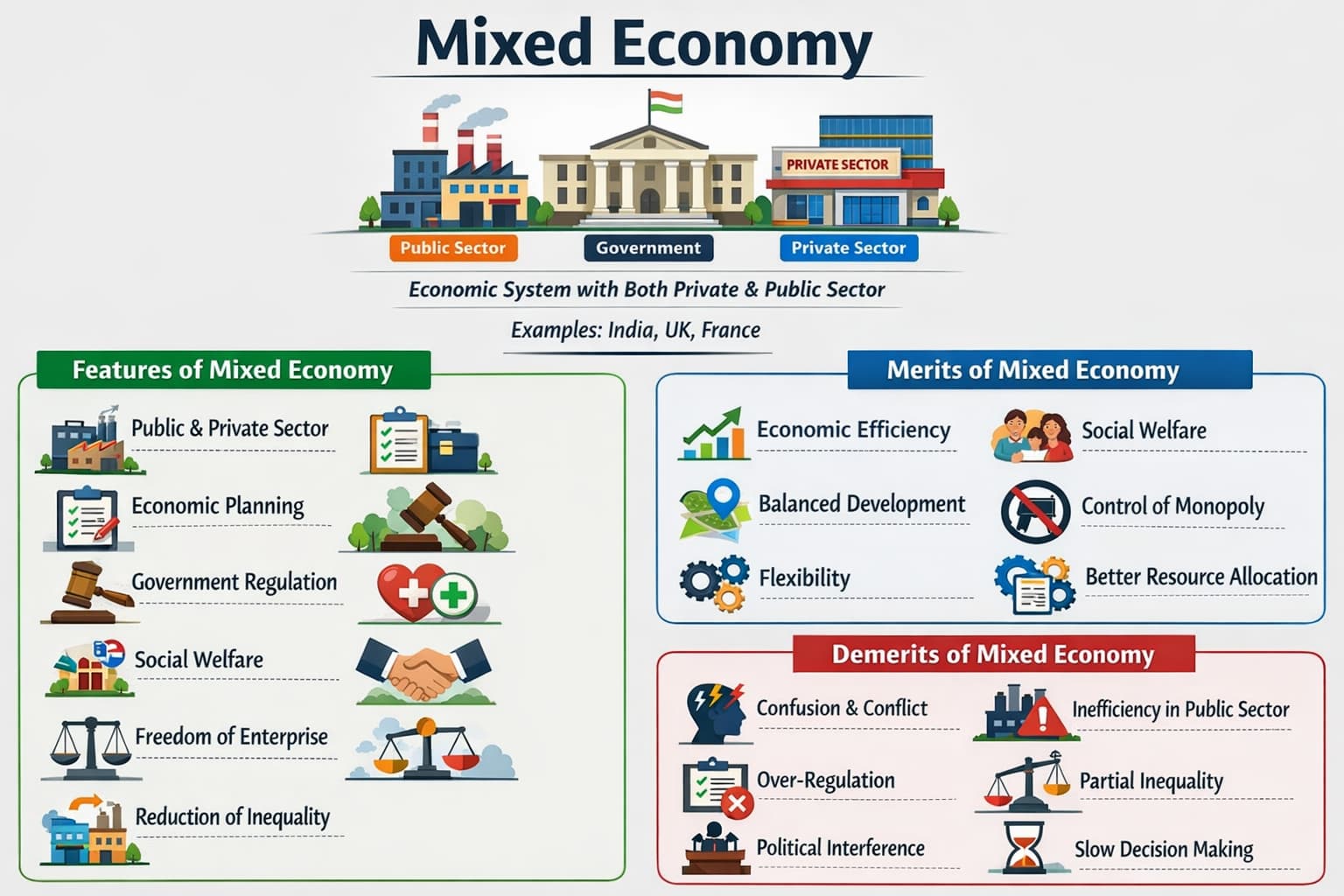
A Mixed Economy is an economic system in which both private sector and government (public sector) work together to run the economy.
It combines features of:
- Capitalist Economy (private ownership, profit motive)
- Socialist Economy (government control for welfare)
Example: Countries like India, UK, and France follow a mixed economy.
Features of Mixed Economy
1. Co-existence of Public and Private Sector
Both government and private individuals run businesses. But, the important industries under government control and Other Sector are open to Private Enterprises.
- Public sector: Railways, defense, etc.
- Private sector: Shops, industries, companies
2. Economic Planning
The government makes plans for development and Planning with flexibility (Like Five Year Plans in India).
3. Government Regulation
Government controls important sectors and regulates private businesses to avoid misuse of resources & also impose liabilities.
4. Social Welfare Objective
Focus is not only on profit but also on public welfare, like education, healthcare, and poverty reduction.
5. Freedom of Enterprise
Private individuals are free to start businesses, but under certain rules and regulation. With Proper Duties and Taxations.
6. Reduction of Inequality
Government takes steps (taxes, subsidies) to reduce the gap between rich and poor. Also, introduce the welfare scheme when needed.
7. Balanced Regional Development
Efforts are made to develop backward areas along with developed ones.
Merits (Advantages) of Mixed Economy
- Economic Efficiency:- Private sector increases efficiency due to competition and profit motive.
- Social Welfare:- Government ensures public welfare through schemes and policies.
- Balanced Development:- Both sectors work together for overall economic growth.
- Control of Monopoly:- Government prevents large companies from dominating the market.
- Flexibility:- It combines the benefits of both capitalism and socialism.
- Better Resource Allocation:- Resources are used wisely under government guidance.
Demerits (Disadvantages) of Mixed Economy
- Confusion and Conflict:- Sometimes conflict arises between government and private sector goals.
- Inefficiency in Public Sector:- Government-run industries may suffer from corruption and lack of efficiency.
- Over-regulation:- Too many rules can discourage private investment
- Partial Inequality:- Income inequality may still exist despite government efforts.
- Political Interference:- Decisions may be influenced by politics rather than economic needs.
- Slow Decision Making:- Government procedures can delay important decisions.
Conclusion
A mixed economy tries to balance economic growth and social welfare by combining the strengths of capitalism and socialism. Although it has some drawbacks, it is considered one of the most practical economic systems in the modern world.