Introduction
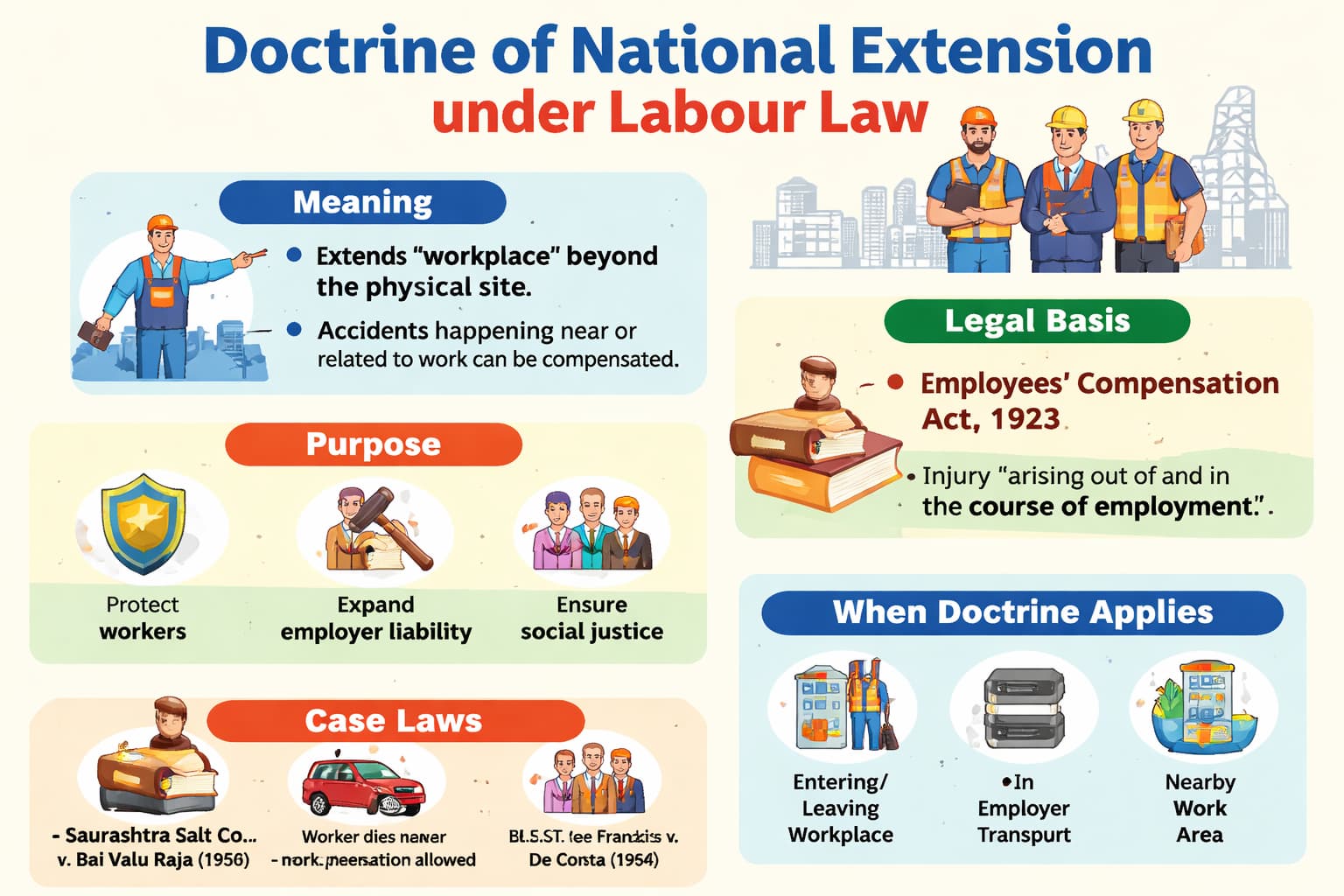
The doctrine of national extension, is outlined in Section 3 of the Workmen’s Compensation Act, 1923 (now known as the Employees Compensation Act), expands the scope of employer liability beyond the traditional boundaries of the physical workplace and conventional working hours. This is legal rule says that employers must give compensation to employees if they get injured in an accident that happens because of their job or during their work.
It covers not only accidents that happen at the workplace, but also those connected to the job. For example, accidents during travel to work or while doing office work outside normal working hours are also included. The main aim of this rule is to understand and reduce the risks related to a job, even if those risks happen outside the workplace.
By thinking in this broader way, the law makes sure that workers get fair compensation for injuries related to their job. It shows that job risks are not limited to just the workplace. This rule (national extension) is important because it protects employees and supports them if they face danger due to their work, no matter where or when the accident happens.
Meaning of Dxteoctrine of National Extension
The doctrine states that the employment is not limited to the factory, office, or workplace, but may extend to nearby areas and situations connected with employment. In simple words: In simple words: If an accident happens while doing something related to the job, even outside the workplace, it may still be treated as a work-related accident.
Essentials of Doctrine of Notional Extension under Section 3(1) of the Workmen’s Compensation Act, 1923
Section 3(1) of the Workmen’s Compensation Act, 1923 explains when an employer must pay compensation to an employee who gets injured during work. It tells us the main conditions for employer liability and worker protection.
1. Accident:
The first condition is that there must be an accident.
- The accident should be sudden and unexpected
- It should not be something that normally happens during work
- It must cause harm to the employee
This means:
- Normal tiredness or small health problems are not considered accidents
- Only unexpected events causing injury are covered
2. Personal Injury:
The second condition is that the employee must suffer a personal injury.
- The injury can be physical (like a fracture) or mental (like stress or shock)
- It must affect the employee’s ability to work or live normally
This ensures:
- Only serious or real injuries are compensated
- Small or minor discomforts are not covered
3. “Arising Out of” and “During the Course of Employment” (Section 3)
- Arising Out of Employment
- This means there must be a connection between the job and the injury.
- The injury should happen because of the nature of the job
- The job should increase the risk of such an accident
- Example:
- If a factory worker is injured by a machine, it is related to the job
- This means there must be a connection between the job and the injury.
- During the Course of Employment
- This means the injury must happen while doing work or job-related activities.
- It is not limited to office or factory only
- It may include:
- Travel for work
- Work done outside normal hours
- Any activity related to the job
- This is connected to the Doctrine of National Extension, which expands the meaning of workplace and working time.
- This means the injury must happen while doing work or job-related activities.
What is “Arising Out of Employment”? (Easy Explanation) under Labour Law
The “arising out of employment” is very important in the Workmen’s Compensation Act. It helps to decide whether the employer is responsible for paying compensation or not.
Meaning of Arising Out of Employment.
“Arising out of employment” means: The injury must be connected to the Job and it should happen because of risks related to the work. In simple words, the accident must occur because of the nature of the job or working conditions. Example:- If a worker gets injured while using a machine at work, the injury is related to the job. So, it arises out of employment.
Important Case Law
In the case of Ramrao Zingraji Shende vs Indian Yarn Manufacturing Company:
- Ramrao was working in a factory
- He got injured while operating a machine
- The company refused compensation, saying he ignored safety rules
But the court said:
- The injury was still related to his job
- So, the employer had to pay compensation
Important Point
Even if the worker is negligent (careless), the employer is still liable unless: There is serious and willful misconduct (like intoxication)
Exception to the Doctrine of National Extension
The Doctrine of National Extension increases employer liability, but there are some exceptions to prevent misuse and false claims.
1. Short-term Disabilities
- If the injury lasts less than 3 days, no compensation is given
- This rule excludes minor injuries
2. Intoxication (Drunken Condition)
- If the employee was drunk or intoxicated at the time of the accident
- The employer is not liable
3. Disobedience of Safety Rules
- If the worker knowingly disobeys safety instructions
- No compensation will be given
4. Removal of Safety Equipment
- If the worker removes or damages safety equipment (like helmet, gloves, etc.)
- The employer is not responsible for injury
5. Public Area Incidents
- If the accident happens in a public place
- And it is not related to the job, but due to personal activity
- No compensation is given
Conclusion
The Doctrine of National Extension plays an important role in labour law by expanding the concept of workplace. It ensures that employees are compensated for accidents connected to their employment, even if they occur outside the physical workplace. This doctrine supports the principle of social justice and worker protection.