
Introduction
A coparcenary is a term which is used in matters related to Hindu Succession Act 1956. A Coparcener is a member of a Hindu Family who acquires an interest in the Ancestral Property by the birth and also have right to demand partition of the Hindu Joint Family Property.
In Hindu Law, there are two types of property:
- Self-Earned Property
- Ancestral Property
And the concept of Coparcener is related to Ancestral Property. And it is narrow concept but Joint Family is wider concept in Hindu Law.
According to Hindu Law, Coparcenary is a narrow body within the Joint Family and consists of persons who have a common ancestor and share joint ownership of property.
Meaning of Coparcener
Under Hindu Law where a person possesses an interest in ancestral or coparcenary property, he is not the sole owner of it and his son, grandson, great-grandson acquire a right by birth in this coparcenary property. A single person cannot from a coparcenary, there should be at least two members in an intergenerational relationship to start a coparcenary. The concept of coparcenary is mainly governed by the Hindu Succession Act, 1956 and traditional Mitakshara School not im Dayabhaga School.
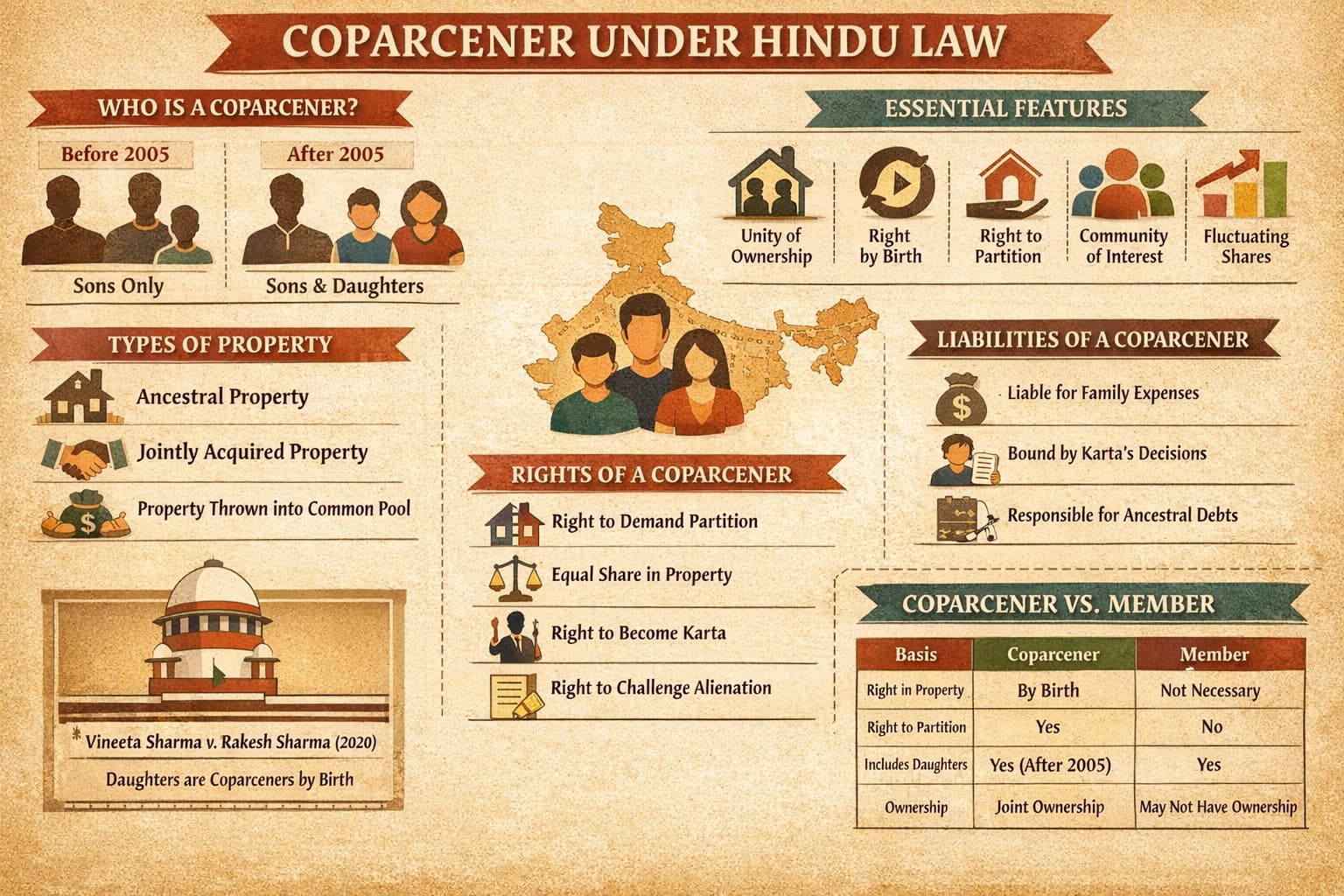
A Hindu Joint Family includes all members (male and female). But a coparcenary includes only those members who have a right in ancestral property by birth. Earlier, only male members were coparceners, but this has changed after legal reforms in 2005. Women have been introduced as coparcener under the Hindu Succession Act(amendment act 2005), the daughter has been given under the section 2(1).
Before 2005 Amendment:
- Only male members (son, grandson, great-grandson) were coparceners.
- Daughters were not included.
After 2005 Amendment:
After the amendment to the Hindu Succession (Amendment) Act, 2005:
- Daughters are also coparceners by birth, just like sons.
- They have:
- Equal rights in property
- Right to demand partition
- Right to become Karta (head of family).
Essential Features of Coparcenary
1. Unity of Ownership
- Property is jointly owned by all coparceners.
- No individual can claim a specific share until partition.
2. Right by Birth
- A coparcener gets rights in ancestral property from birth, not by succession.
3. Right to Partition
- Every coparcener can demand partition at any time.
4. Common interest
- All coparceners have a common interest and possession in property.
5. Fluctuating Shares
- Share of each coparcener changes with births and deaths in the family.
Liabilities of a Coparcener
- Liable to contribute to family expenses
- Bound by lawful acts of the Karta
- Responsible for ancestral debts (with limitations)
Generation Difference in Joint Family and Coparcener
A person who is more than four degrees removed from the senior-most member is not considered a coparcener. The concept of four generations includes the senior-most member. Those who come after these four generations are only members of the joint family, not coparceners. The joint family can extend up to seven generations.
Example:- Father > Son > Grandson > Greater Grand Son = Coparcener
Coparcener in Case Illegitimate Son
All illegitimate son of a lineal male of descendant is a member of Joint Family but is not a coparcener. If a partition takes place between the father and the sons, illegitimate son can be alloted a share. Case: Gur Narain Das vs. Gur Tahal Das 1952)
The Father can give equal share to the illegitimate son. However after the dead of the father, if a partition take place, the illegitimate son, will get half of the share of legitimate son.
Coparcener in Case Insane Person
An insane male member of the family is not a coparcener and his rights are temporarily suspended till he recovers but, if a partition takes place, he has to be alloted a share.
Ouster from Coparcenary
Ceases to member of joint family
- Renouncement and conversion of Religion
- Get married to a non-Hindu under the Special Marriage Act, 1954
But in both cases his rights in the coparcenary property will not be forfeited and he is entitled to take share of the property.
Conclusion
A coparcener is a crucial concept in Hindu law representing those family members who have birthright ownership in ancestral property. The law has evolved to ensure gender equality, especially after the 2005 amendment, making daughters equal coparceners. This reflects a modern and just approach in property rights within Hindu families.