Introduction
Succession means succeeding or following in general day to day language, but here it means succeeding or passing of rights of property from one to another. As, we know there are two types of succession such as:-
- Testamentary Succession (which means with the will)
- Instate Succession (which means without will)
The Hindu Succession Act 1956 governs the rules of inheritance among the Hindus, there are separate or different provisions for the Hindu Male and Hindu Female in case of Instate Succession. When the Hindu male dies instate (without making a will), his property devolves according to the provisions of this act, mainly under Section 8,9,10 of the Hindu Succession Act 1956.
Applicability of Hindu Succession Act 1956:- These rules are apply on the Hindus, Buddhists, Jain and Sikhs.
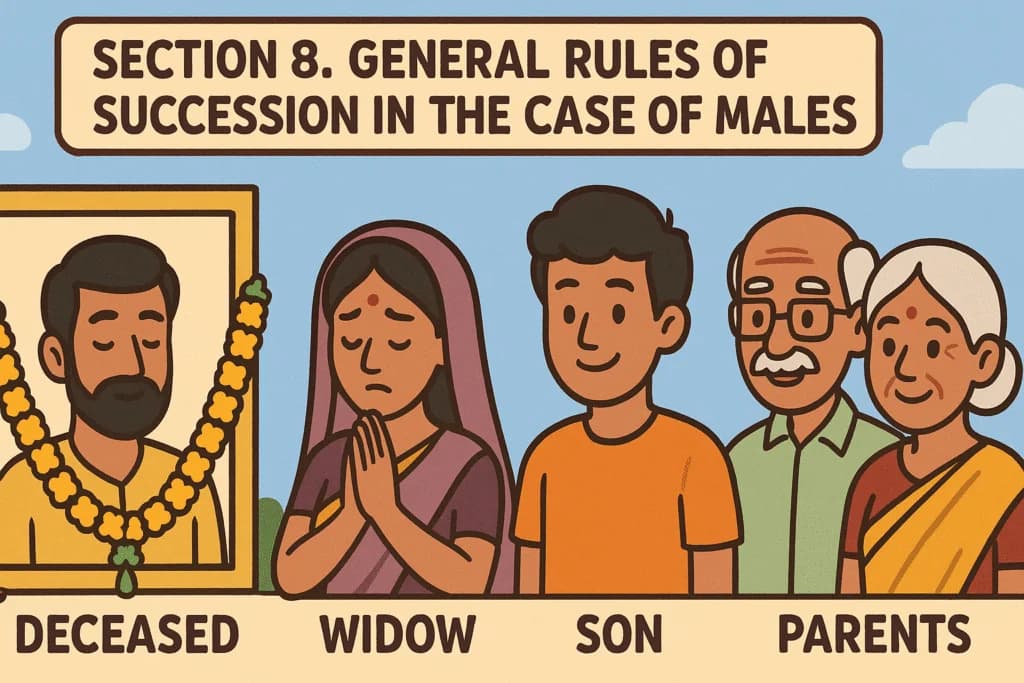
General Rules of Instate Succession Hindu Male (Section 8)
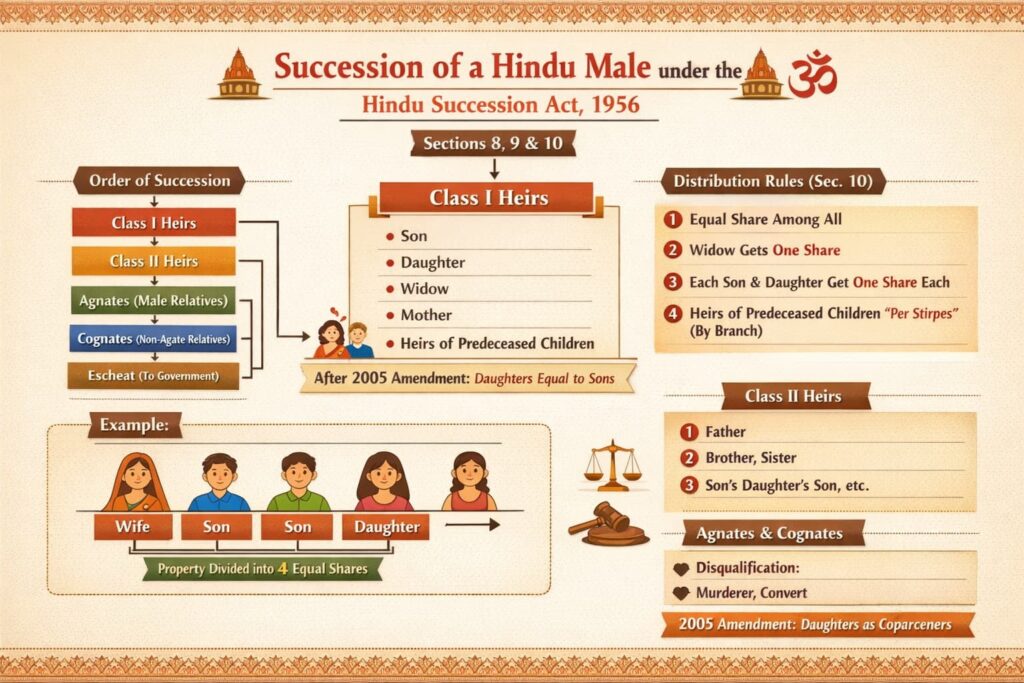
General Rules of Successions Property of the Hindu Male devolves in the following order:-
- Class 1 Heirs(Property goes to Class I heirs)
- Class 2 Heirs(If no Class I heir exists, then to Class II heirs)
- Agnates(If no Class I or II heirs, then to agnates (relatives through male lineage)
- Cognates(If no agnates, then to cognates (relatives not wholly through males).
Note:- Class 1&2 Heirs are lists were given in he schedule of Hindu Succession Act 1956.
Class 1 Heirs According to Hindu Succession act 1956 are:-
1. Mother:-
- Includes Adoptive Mother, Adoptive mother will exclude natural Mother, Means: If a child is adopted, only the adoptive mother is considered the real mother for property matters, not the natural mother.
- “Mother” includes adoptive mother
- After valid Adoption
- Child becomes the legal child of adoptive parents
- Adoptive mother gets inheritance rights
- Natural mother is excluded (Left Out)
- A mother is also entitled to inherit the property of her illegitimate son by virtue of section 3(1) (j). Simply Means That:- Even if the child is born outside marriage, his mother can still get his property.
- Case:- Jayalakshmi Ammal And Ors. vs. TU Ganesa Iyer 1971
- Court said:-
- Adoptive mother is treated as real mother
- She will inherit property instead of natural mother
- Adoption creates a complete new legal relationship
- In Easy Language:- Once adoption happens, old (natural) relationship ends and new (adoptive) relationship starts fully.
- Court said:-
2. Son and Daughter:-
Adopted children also included, children born out of void/voidable marriage also legitimate children according to section 16 of Hindu Marriage Act 1955.
- Adopted Children:-
- An adopted child is treated as a real (natural) child of adoptive parents.
- Adopted child = same rights as real child.
- Children of Void Marriage:-
- Void marriage = invalid marriage (like bigamy).
- But children born from it are considered legitimate.
- Even if marriage is illegal, child is still legal.
- Children of Voidable Marriage:-
- Voidable marriage = valid until cancelled by court.
- Children born before cancellation are legitimate.
- If marriage later breaks, child still remains legal.
3. Widow:-
If there are more than one widow they will inherit one share jointly (widow of the dead is entitled to inherit from ex- husband’s property even if she remarries after his death).
- Rule of More Than One Widow:-
- Under the Hindu Succession Act, 1956: If a man has more than one widow:
- All widows will share one single share jointly
- They do not get separate shares
- All widows together are treated as one unit (one person) for inheritance.
- Example:-
- A man dies leaving:
- 2 widows (Wife 1 and Wife 2)
- 1 son
- Property will be divided into 2 shares only:
- 1 share → Son
- 1 share → Both widows together
- Then widows will divide their share among themselves:
- Wife 1 = ½ of widow’s share
- Wife 2 = ½ of widow’s share
- A man dies leaving:
- Under the Hindu Succession Act, 1956: If a man has more than one widow:
- Widow’s Right After Remarriage:-
- A widow can inherit her husband’s property
- Even if she remarries after his death, her right does not end
- Meaning: Remarriage does not cancel her inheritance right.
4. Widow of the pre-deceased son: widow of predeceased son of a predeceased son:-
Her share including the share of children of predeceased son shall be not more than the share of predecease son.
- Widow of Pre-Deceased Son:- Under the Hindu Succession Act, 1956:
- If a son dies before his father, he is called a pre-deceased son.
- His widow and children will take his place in inheritance.
- Main Rule:-
- The widow + children of the pre-deceased son together will get only that share which the son would have got if he were alive.
- Their total share cannot be more than the son’s share.
- Example:-
- A father dies leaving:
- 1 living son (A)
- 1 pre-deceased son (B)
- B’s widow + 2 children
- Property will be divided into 2 shares:
- 1 share → Son A
- 1 share → B’s family (widow + children)
- Then B’s share is divided:
- Widow + children will divide that 1 share among themselves
- They cannot claim more than B’s share
- A father dies leaving:
5. Son/Daughter of Pre-Deceased Son/Daughter of Predeceased Son/Daughter
The son/daughter of a pre-deceased son/daughter will get only the share which their parent would have got if alive. They cannot get more than that share.
- Simple Meaning:–
- They step into the shoes of their dead parent
- They take their parent’s share only
- Example:-
- A man dies leaving:
- 1 living son (A)
- 1 pre-deceased daughter (B)
- B has 2 children (C and D)
- Property divided into 2 shares:
- 1 share → Son A
- 1 share → B’s children (C & D)
- Then C and D divide B’s share:
- C = ½ of B’s share
- D = ½ of B’s share
- They cannot claim more than B’s share
- A man dies leaving:
Class 2 Heirs According to Hindu Succession act 1956 are:-
Only one entry inherits at a time. (Basic Rule of Inheritance)
1. Entry 1 (Father)
Including adoptive father, father is not entitled to property from illegitimate son unlike mother but he is entitled to inherit property from children born out of void and voidable marriages.
- Father (including adoptive father) is a Class II heir.
- He cannot inherit from illegitimate son.
- He can inherit from children of void/voidable marriages.
2. Entry 2 of Instate Succession Hindu Male
- Son’s Daughter son
- Son’s Daughter’s Daughter
- Brother
- Sister
3. Entry 3 of Instate Succession Hindu Male
- Daughter’s son’s son
- Daughter’s son’s daughter
- daugther’s daughter’s son
- daughter’s daughter’s daughter’s
4. Entry 4 of Instate Succession Hindu Male
- Brother’s Son
- Sister’s Son
- Brother’s Daughter
- Sister’s Daughter
5. Entry 5 of Instate Succession Hindu Male
- Father’s father;
- father’s mother.
6. Entry 6 of Instate Succession Hindu Male
- Father’s widow;
- Brother’s widow.
7. Entry 7 of Instate Succession Hindu Male
- Father’s Brother;
- Father’s Sister
8. Entry 8 of Instate Succession Hindu Male
- Mother’s father;
- mother’s mother
9. Entry 9 of Instate Succession Hindu Male
- Mother’s Brother;
- Mother’s sister
Class 3 Agnates. Section 3 (1)(j) of Hindu Succession act 1956 are:
One Person is said to be an agnate of another if the two are related by blood or adoption wholly through males. Agnates of the instate do not includes widows.. These is no limit to the degree of relationship by which agnates recognized.
Hence, an agnates however remotely related to the intestate may succeed as an hier
- This relationship does not distinguish between male and female heirs
- There is also no distinction between those related by full and half blood. However uterine relationship is not recognized.
- Example:- Tau’s son
- Father’s brother (uncle)
- Father’s brother’s son (cousin)
- Son’s son
- Not agnates:
- Mother’s brother (because relation through female)
- Sister’s son
Cognates Section 3(1)(c) of of Hindu Succession act 1956
Cognates are persons who are related to the deceased through at least one female link. Relation can be by blood or adoption But there must be at least one female in the relationship chain.
Example:-
- Mother’s brother (maternal uncle)
- Sister’s son
- Father’s sister (aunt)
Because in all these, female link is present
Section 9 – Order of Succession of Instate Succession Hindu Male
Under the Hindu Succession Act, 1956:
Main Rules
- Class I Heirs First
- Property goes first to Class I heirs
- They have absolute preference
- Then Class II Heirs
- If no Class I heir, then Class II heirs inherit
- They follow entry-wise priority:
- Entry I preferred over Entry II, and so on
- Then Agnates
- If no Class I and Class II heirs
- Property goes to agnates (male-line relatives)
- Then Cognates
- If no agnates
- Property goes to cognates (female-link relatives)
Section 10 – Distribution of Property among Class I Heirs
This section explains how property is divided among Class I heirs.
- Equal Share Rule:- All Class I heirs get equal share
- Example:
Mother, son, daughter → all get equal part
- Example:
- Rule of Branch (Per Stirpes)
- If a son or daughter dies before, their share goes to their children (grandchildren)
- They divide that parent’s share only
- Widow’s Share:- If there are multiple widows:
- They get one share together
- Then divide it among themselves
Section 11 – Distribution among Class II Heirs
This section explains how property is divided among Class II heirs.
- Entry-wise Preference:-
- Class II heirs are divided into entries (Entry I, II, III, etc.)
- First available entry gets full property
- Example: If father (Entry I) is alive → he gets all property
- No Sharing Between Entries:-
- If one entry has heirs → next entries are ignored
- Equal Share within Same Entry
- If more than one heir in the same entry:
- They share equally
- Example:- If Entry II has 2 heirs → each gets ½ share
Section 12 – Order of Succession among Agnates and Cognates
This section explains how to decide priority among agnates and cognates.
- Nearer Relative Preferred:-
- The relative who is closer in relation gets preference
- Fewer Degrees Preferred:-
- Person with less number of steps (degrees) is preferred
- Example:-
- Father’s brother (2 steps) preferred over
- Father’s brother’s son (3 steps)
- Same Degree → Equal Share
- If two relatives are at same level (same degree):
- They get equal share
Disqualification of Heirs Instate Succession Hindu Male
Certain persons are disqualified:
- Murderer of the deceased
- Converted Hindu (in some situations)
Amendment of 2005 (Important)
- Daughters became coparceners by birth.
- Equal rights in ancestral property.
Conclusion
The Hindu Succession Act, 1956 provides a systematic and hierarchical scheme for succession: Priority to Class I heirs and then Class II, agnates, and cognates. Also, Ensures equality and fairness, especially after the 2005 amendment