
Introduction
Natural justice has been understood in different ways by different writers, lawyers, and legal systems. Sometimes, it is used as another name for Divine Law, Jus Gentium (law of nations), or Common Law. The meaning of natural justice is not fixed; it keeps changing with time. However, this does not mean that at any particular time there are no clear principles of natural justice.
Through various court decisions, the principles of natural justice can be clearly identified. But their application depends on the facts and circumstances of each case. In a welfare state like India, the powers and functions of administrative authorities are increasing very fast. The Rule of Law will lose its importance if government authorities are not required to act fairly, justly, and reasonably while performing their duties.
The principles of natural justice are strongly supported by different Articles of the Indian Constitution. After the introduction of the concepts of substantive and procedural due process under Article 21, all the ideas of fairness included in natural justice are considered part of Article 21, especially when a person’s life or personal liberty is taken away.
In other matters, Article 14 of the Constitution protects the principles of natural justice. Article 14 not only prohibits discriminatory laws, but also arbitrary and unfair actions by the State. Since the violation of natural justice leads to arbitrariness, it automatically becomes a violation of Article 14, which guarantees equality.
Therefore, the principles of natural justice cannot be completely ignored by law, because doing so would violate the fundamental rights guaranteed under Articles 14 and 21 of the Indian Constitution.
Meaning of Natural Justice
Natural justice means acting fairly, reasonably, and impartially. It is the minimum standard of fairness that must be followed by authorities while making decisions that affect the rights, liberty, or property of a person. In simple words, justice should not only be done but should also appear to be done.
Meaning:- Natural Justice implies fairness, reasonableness, equity and equality. Natural Justice is a concept of Common Law and it is the Common Law world counterpart of the American concept of ‘procedural due process’. Natural Justice represents higher procedural principles developed by judges which every
administrative agency must follow in taking any decision adversely affecting the rights of a private individual.
Principle of Natural Law are:-
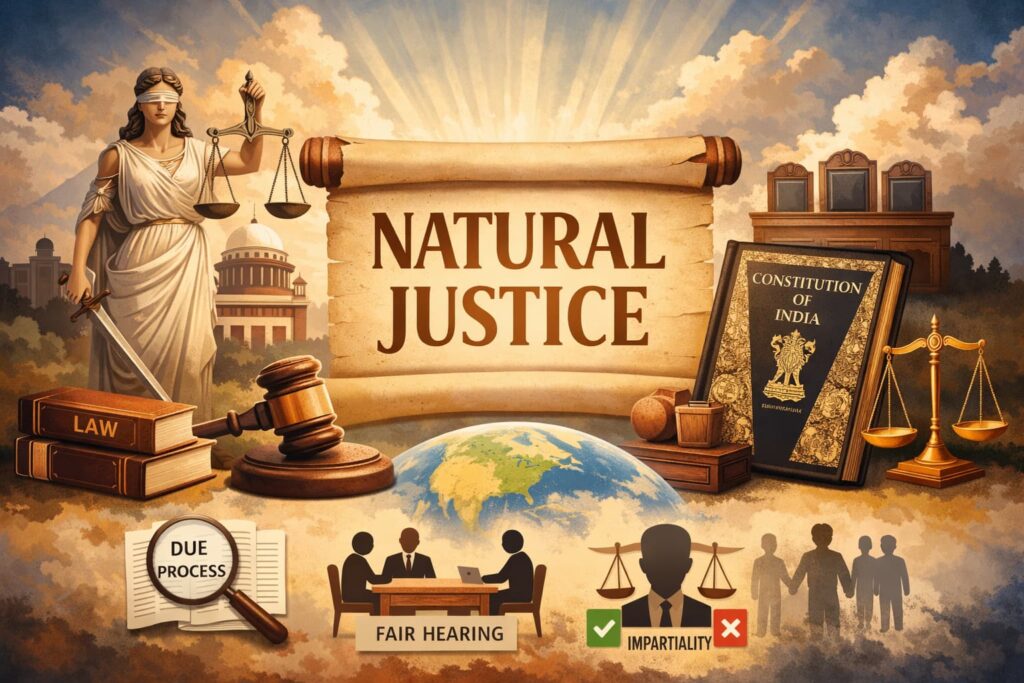
There are mainly two Principles of Natural Justice. These two Principles are:
1. ‘Nemo judex in causa sua’ (Rule against Bias)
No one should be made a judge in his own cause the rule against bias The decision-maker must be impartial and free from personal interest.
Meaning of Rule Rule Against Bias in details:
Bias means an unfair attitude or prejudice, whether a person is aware of it or not, against a party or an issue in a case. Because of this, the rule against bias aims to prevent any factors that may wrongly influence a judge or decision-maker while giving a decision. This principle requires that the judge or authority must act fairly, impartially, and without personal interest while deciding a case. If a person, for any reason, cannot make a fair and objective decision based on the evidence, then that person is considered to be biased. A person cannot decide fairly in a case where he or she has a personal interest, because human nature shows that people usually find it difficult to decide against their own interests.
This rule of disqualification exists not only to prevent unfair or partial decisions, but also to maintain public confidence in the fairness of administrative and judicial processes. This is why the principle says that no one should be a judge in their own case, and that justice should not only be done but should clearly appear to be done. The minimum requirement of natural justice is that the authority deciding the case must consist of impartial persons who act fairly and without prejudice or bias. Any decision made because of bias is invalid, and such a proceeding is called “coram non judice”, meaning it has no legal authority.
Bias can be concluded only on the basis of facts and real circumstances, and not on mere doubts, assumptions, or guesses. Bias can appear in different forms and can influence a decision in many ways.
Types of Bias are:-
- Personal Bias:- Personal bias arises when a decision-maker has a personal or professional relationship with a party that may affect fairness. To challenge a decision on this ground, it is not necessary to prove actual bias. What is required is proof of a reasonable and real likelihood of bias. Courts look at the situation from the view of a reasonable and fair person, considering normal human behaviour. Mere doubt or imagination is not enough. Only when there is a real possibility of bias, the proceedings can be set aside to ensure justice and fairness.
- Pecuniary Bias:- Pecuniary bias means financial interest in a case. Courts are very clear that any amount of financial interest, even a very small one, can make a decision unfair. If a person involved in decision-making has a financial interest, the decision becomes invalid. Even if that person does not actively take part in the discussion, their mere presence during the proceedings is enough to create bias. In one case, the Supreme Court cancelled the decision of the Textbook Selection Committee because some of its members were authors of the books that were being considered for selection. Since they could benefit financially, the decision was held to be biased.
- Subject Matter Bias:-Those cases fall within this category where the deciding officer is directly, or otherwise, involved in the subject matter of the case. Here again mere involvement would not vitiate the administrative action unless there is a real likelihood of bias. In a case the Supreme Court quashed the decision of the Andhra Pradesh Government, nationalizing road transport on the ground that the Secretary of the Transport Department who gave hearing was interested in the subject-matter.
- Departmental Bias:- The problem of ‘departmental bias’ is something which is inherent in the administrative process, and if it is not effectively checked, it may negate the very concept of fairness in the administrative proceeding. The problem of ‘departmental bias’ also arises in a different context, when the functions of judge and prosecutor are combined in the same department. It is not uncommon to find that the same department which initiates a matter also decides it, therefore, at times departmental fraternity and loyalty militates against the concept of fair hearing.
- Preconceived Notion Bias:- Bias’ arising out of preconceived notions is a very delicate problem of administrative law. On the one hand, no judge as human being is expected to sit as a blank sheet of paper, on the other, preconceived notions would vitiatea fair trial. The problem of bias arising from preconceived notions may have to be disposed of as an inherent limitation of the administrative process It is use less to accusea public officer of bias merely because he is predisposed in favour of some policy in the public interest. Bias would also not disqualify an officer from taking an action if no other person is competent to act in his place. This limitation is grounded on the doctrine of necessity.
2. ‘Audi alteram partem’ (Right to heard):-
This principle means hear the other side. No person should be punished or adversely affected without being given a fair opportunity to present his case. (For Deep Studies)The Rule simply implies that a person must be given an opportunity to defend himself/herself. This principle is a ‘sine qua non’ of every civilized society. Corollary deduced from this rule is “ qui aliquid statuerit, parte inaudita altera aeuquum licet dixerit, haud aequum facerit” (he who shall decide anything without the other side having been heard although he may have said what is right will not have done what is right). The same principle was expressed by Lord Hewart when he said, “ It is not merely of some importance, but is of fundamental importance that justice should not only be done, but should manifestly and undoubtedly be seem to be done’’. Administrative difficulty in giving notice and hearing to a person cannot provide any justification for depriving the person of opportunity of being heard. Furthermore, observance of the rules of natural justice has no relevance to the fatness of the stake but is essentially related to the demands of a given situation. Even if the legislature specifically authorizes an administrative action without hearing, except in cases of recognised exceptions, then the law would be violative of the principles of fair hearing as per Articles – 14 and 21 of the Indian Constitution. However, refusal to participate in enquiry without valid reason cannot be pleaded as violation of natural justice at a later stage.
1. Notice of the case: A person must know the charges or issues against him/her before defending himself/herself. Without proper notice, a person cannot prepare an effective defence.
- Giving notice is not enough — the notice must be adequate and clear. Adequate notice means it must contain:
- Clear details of the charges or issues
- Relevant facts and information
- Sufficient time to respond
- Whether a notice is adequate depends on the facts of each case. The real test is whether the notice gives enough information to allow the person to defend properly.
- The contents of the notice, the person receiving the notice, and the time given to reply are important to check whether natural justice has been followed. For example, if only 24 hours are given to demolish a building, the court may say the notice is unfair because there was not enough time.
- Also, if the notice mentions only one charge, the person cannot be punished for any other charge not mentioned in the notice.
- However, notice is not required as a mere technical formality. If the person already clearly knows the case against him/her and suffers no prejudice, then absence of formal notice may not invalidate the action.
2. Right to Present Case and Evidence:- Under natural justice, a person must be given a reasonable opportunity to present his/her case before any action is taken. This opportunity may be given in writing or orally, depending on the law and the situation.
Simply giving information is not enough. The opportunity must be real and meaningful, so the person can properly defend himself/herself. However, there is no need to give two separate opportunities — one chance to respond is sufficient.
Oral hearing is not always necessary. It becomes important only in special cases, such as when the matter is complex, technical, or very serious. If the law does not specifically require oral hearing, courts decide based on the facts and circumstances of each case.
3. The Right to Rebut Adverse Evidence The right to rebut adverse evidence presupposes that the person has been informed about the evidence against him. This does not, however, necessitate the supply of adverse material in original in all cases. It is sufficient if the
summary of the contents of the adverse material in made available provided it is not misleading. The opportunity to rebut evidence necessarily involves the consideration of two factors: cross-examination and legal representation.
4. Cross-Examination:- ‘Cross-examination’ is the most powerful weapon to elicit and establish truth. However, the Courts do not insist on ‘cross-examination’ in administrative adjudication unless the circumstances are such that in the absence of it the person cannot put up an effective defence. Where the witnesses have orally deposed, the refusal to allow cross-examination would certainly amount to violation of the principles of natural justice. In the area of labour relations and disciplinary proceedings against civil servants also, the right to cross-examination is included in the rule of fair hearing.
5. Legal Representation:- Legal representation means the right of a person to be represented by a lawyer or legal expert in legal or administrative proceedings. It is an important part of the principle of natural justice, especially under the rule of audi alteram partem (right to be heard).
Generally, there is no absolute right to legal representation in every administrative proceeding unless it is provided by the statute. However, courts may allow legal representation in certain situations, such as:
- When the case involves complex legal or technical issues
- When the charges are serious
- When the opposite party is represented by a lawyer
- When denial of a lawyer would cause serious prejudice
If refusal to allow legal representation results in unfairness, it may amount to a violation of natural justice.
Conclusion
Natural justice is the backbone of a fair legal system. It ensures that decisions are made without bias, after giving a fair hearing, and with proper reasoning. Even though it is not codified, it plays a crucial role in protecting individual rights and maintaining justice in administrative and judicial processes.