WHY WAS IT DECLARED ? ( DECLARATION OF EMERGENCY )
- On 12 June 1975, Justice Jagmohan Lal Sinha of the Allahabad High Court passed a judgement declaring Indira Gandhi’s election to the Lok Sabha invalid.
- This order came on an election petition filled by Raj Narain, a socialist leader and a candidate who had contested against her in 1971.
- The petition challenged the election of Indira Gandhi on the ground, that she had used the services of government servants in her election campaign.
- JUDGEMENT OF HIGH COURT : Legally she was no more an MP ( Member of Parliament ) and could not remain the PM ( Prime Minister ) unless she was once again elected as an MP within next six months.
- On 24 June Supreme Court granted partial stay on High Court order that Indira Gandhi could remain an MP but could not take part in the proceedings of Lok Sabha.
CRISIS AND RESPONSE
- JP ( Jayaprakash Narayan ) pressed for Indira Gandhi’s resignation and organised a massive demonstration in Delhi’s Ramlila Ground on 25 June 1975.
- JP announced Nationwide Satyagraha for her resignation and asked Army, Police, Government Employees not to obey illegal or immortal orders.
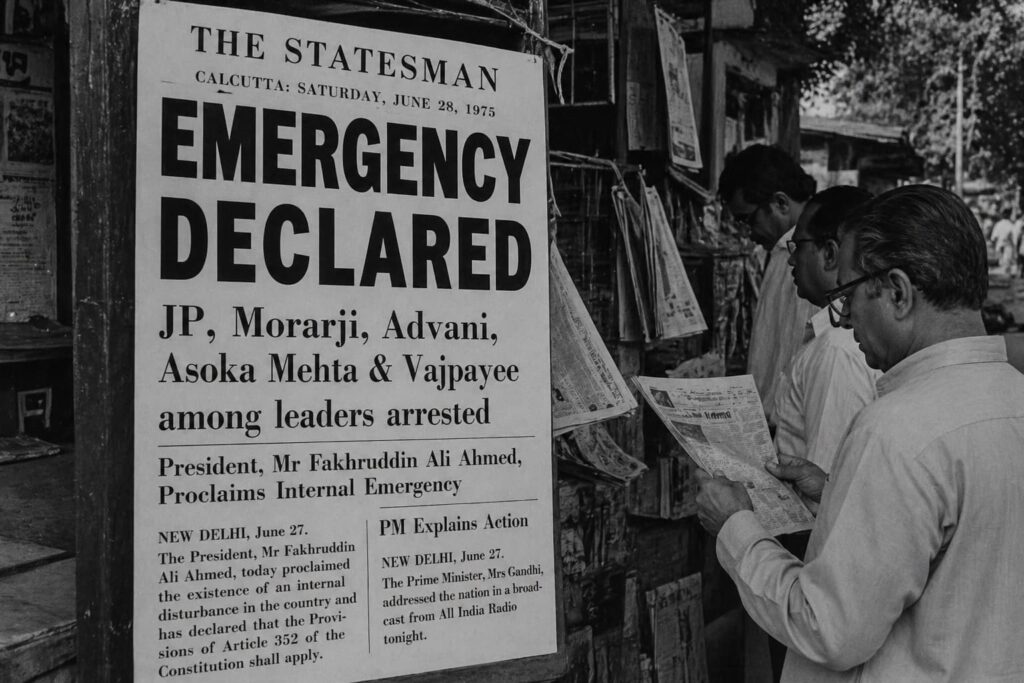
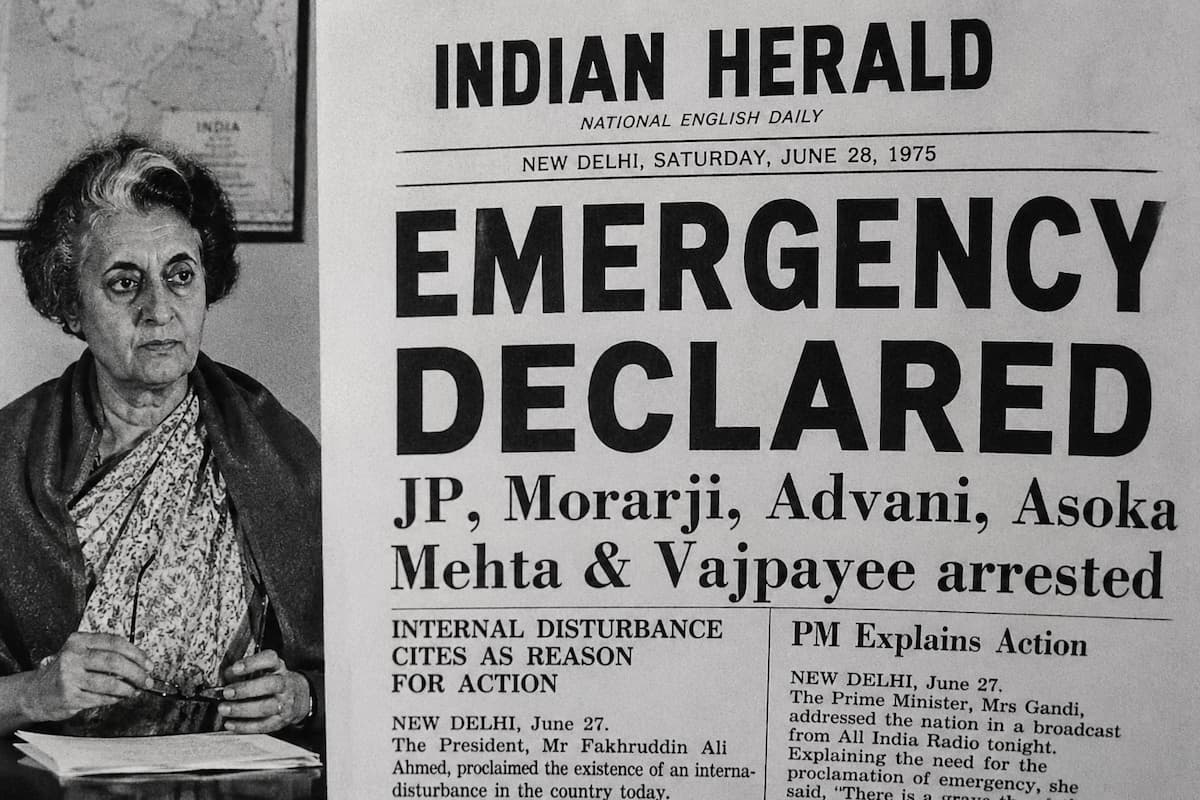
- The RESPONSE OF GOVERNMENT was to declare a State of Emergency. On 25 June 1975 the Government declared that there was a Threat of Internal Disturbances and it invoked Article 352 of the constitution. ( Under this the Government could declare a state of emergency on grounds of external threat or a threat of internal disturbances ).
ONCE THE EMERGENCY IS PROCLAIMED
- The Federal Distribution of Powers came in control of Union Government, also the governments gets power to restrict all or any Fundamental Rights during Emergency.
- On 25 June 1975 ( night ) PM recommended the imposition of emergency to President Fakhruddin Ali Ahmed.
- After midnight, the electricity to all the major newspaper offices was disconnected.
- In early morning, a large number of leaders and workers of the opposition parties were arrested.
- Cabinet was informed about it at a special meeting at 6 a.m. on 26 June.
CONSEQUENCES
- Suspension of Fundamental Rights
- Freedom of Speech, Expression, and Assembly were suspended.
- Citizens could not protest or criticize the government.
- Press Censorship
- Newspaper, Radio, and TV were strictly controlled.
- Only Pro-Government news was allowed, critical reporting was banned.
- Arbitary Arrests ( Mass Arrests under (MISA) Maintenance of Internal Security Act )
- Thousands of political opponents and activists were arrested without trial.
- Many were kept in prisons for long periods without charges.
- Suppression of Democracy
- Free elections and public debates were undermined.
- Opposition leaders were silenced to stop protests.
- Long Term Impact
- Created fear among people and showed the importance of protecting civil rights and press freedom.
- Reforms were introduced after 1977 to prevent misuse of power.
- Forced Sterilization Program
- One of the major abuses was the forced sterilization campaign led by Sanjay Gandhi.
- Millions of poor and helpless people were sterilized without their full consent as part of population control measures.
RESULTS (OUTCOME)
- Fall of Government
- In the 1977 general elections, Indira Gandhi and the Congress Party were defeated due to public anger against Emergency policies. The Janata Party came to power for the first time at the Centre.
- New Leadership
- Morarji Desai became Prime Minister, heading the first non-Congress Government in India. This marked a major shift in Indian politics and ended Congress dominance temporarily.
- Constitutional Safegrounds
- The 44th Constitutional Amendments was passed to prevent misuse of emergency powers. It restored and strengthened Fundamental Rights and limited the government’s authority to suspend them.
- Public Awareness
- The Emergency made citizens more aware of their democratic rights and freedoms. People became more politically conscious and cautious about authoritarian rule in the future.
- Importance of Free Media
- The strict censorship during emergency highlighted the need for an independent press. Afterward, media gained greater importance as a watchdog of democracy.
- Import on Institutions
- The role of the Judiciary and Administration during Emergency led to a loss of public trust. It exposed weakness in democratic institutions and the need for their independence.
GOVERNMENT’S VIEW
- Let the Ruling Party govern according to policies.
- Frequent protest is not good for democracy.
- Cannot continuously have extra-parliamentary politics targetting government.
- It leads to distract government from routine task for development.
- Energies are diverted to maintain law and order
- Indira Gandhi’s subversive forces were trying to obstruct the progressive programs.
JP (Jayaprakash Narayan) AND OPPOSITION VIEWS
- People had right to publicly protest against the government.
- Bihar and Gujarat agitation were peaceful and non-violent.
- Who were arrested were never tried for any anti-national activity.
- Home Ministers did not express any concern about law and order.
- If protest had over-stepped limits, government led enough power to deal with it.
- The threat was not to the unity and integrity of the nation but to the ruling party and to the PM.
KEY IMPACT
- Emergency was considered as the Darkest Period Of Indian Democracy.
- Led to the stronger safeguards against misuse of power.
CONCLUSION
The Emergency (1975-1977) declared by Indira Gandhi exposed serious weaknesses in India’s democratic system, including misuse of power and suppression of rights. However, its aftermath – especially reforms like the 44th Constitutional Amendment – strengthened democratic safeguards and made citizens more aware. Thus, it remains both a warning against authoritarianism and a turning point that reinforced Indian democracy.