Introduction
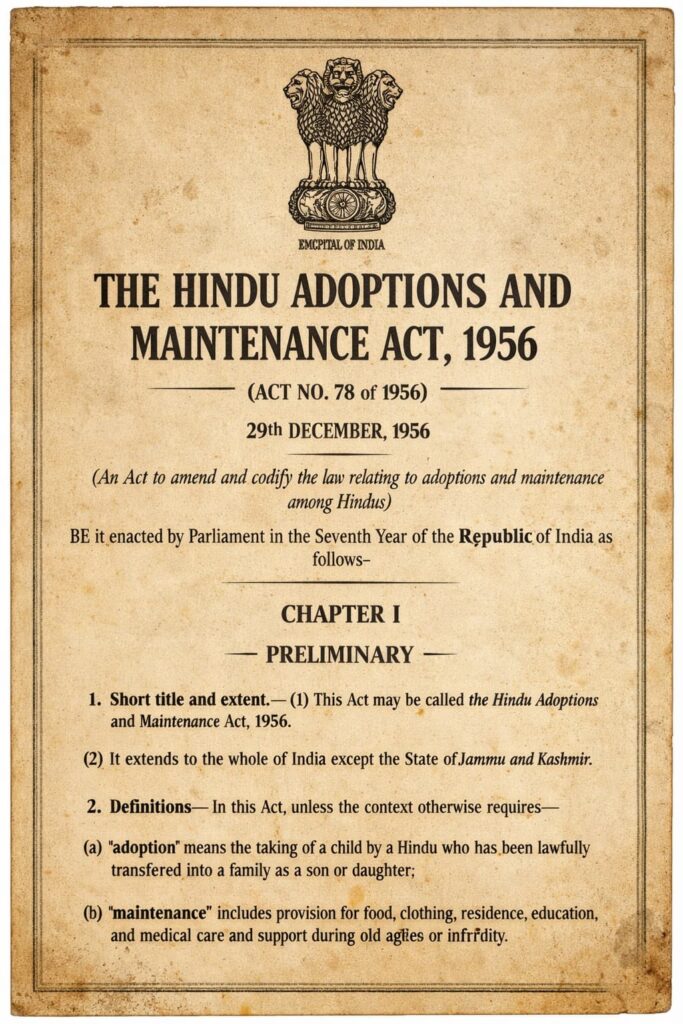
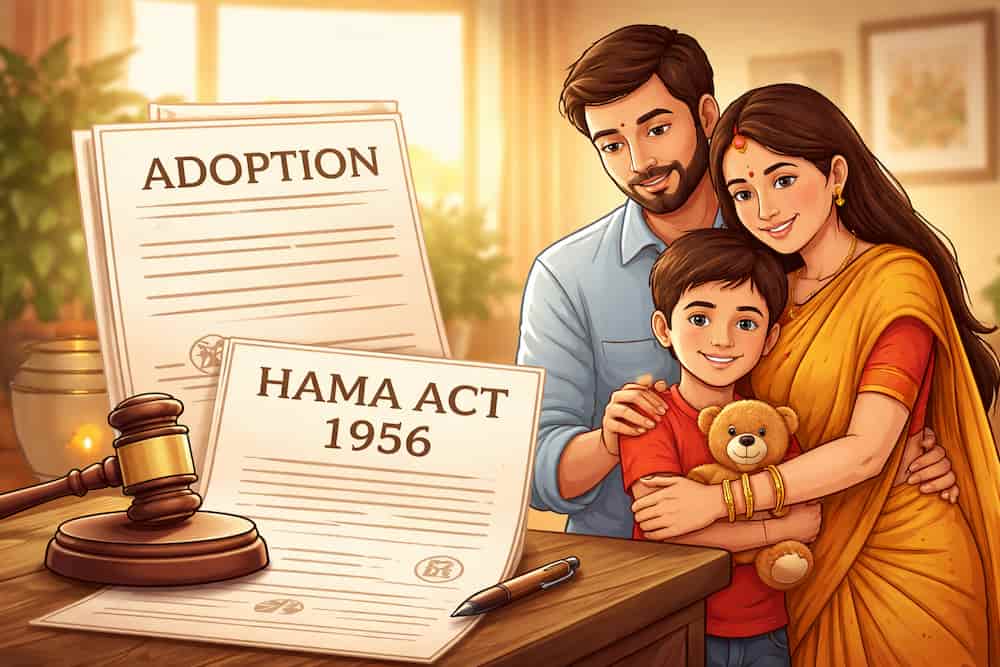
The term Adoption is described under the Hindu Adoptions and Maintenance Act, 1956 (HAMA). It simply means that legally taking a child from another family and treating that child as one’s own child or the adopted child is permanently separated from his biological parents and becomes the lawful child of the adoptive parents with all the rights and privileges and responsibilities that are attached to a biological child.
The Hindu Adoptions and Maintenance Act, 1956 (HAMA) lays down certain mandatory conditions that must be fulfilled for a valid adoption. If these conditions are not satisfied, the adoption becomes invalid in the eyes of law. And this law also regulates or includes the inheritance rights, the duty of maintenance, and parental responsibilities. Hence, the law carefully regulates who can adopt, who can be adopted, and how adoption must be carried out in legal way.
Extent of the Hindu Adoption and Maintenance Act, 1956
This law is extents or mainly applies on the Hindus, Buddhists, Jains, and Sikhs. It sets out the conditions for a valid adoption, the capacity of adopters and adoptees, the rights and duties of adoptive parents, and the legal consequences of adoption. The Act came into effect to provide a uniform law for adoption among Hindus and to protect the welfare of the children.
Valid and Void Adoptions (Section 5) of HAMA Act, 1956
- . Adoption must follow the law:- This section says that any adoption made after the start of the Hindu Adoptions and Maintenance Act, 1956 must follow the rules given in this act under chapter 2.
- If a Hindu person adopts a child according to the legal conditions of the Act, the adoption is valid.
- If the adoption breaks any rule of the Act, the adoption becomes void (invalid).
- Note:- If a person adopts a child without following the legal requirements (like proper consent, eligibility, etc.), the law will treat that adoption as not valid.
- Effect of a void adoption:-
- No rights are created in the adoptive family:- The adopted child will not get any legal rights in the adoptive family (like inheritance or family status).
- Birth family rights remain the same:- The child will continue to have rights in his/her original (birth) family because the adoption is not legally recognized.
- Example:
- If an adoption is invalid:
- The child cannot claim property in the adoptive family.
- The child still remains legally part of the biological family.
- Importance of this Section:-
- Ensure legal and proper adoption procedures.
- Prevent illegal or fraudulent adoptions.
- Protect the rights of children and families.
- Maintain clarity about family relationships and property rights.
Essentials of a Valid Adoption (Section 6) of HAMA Act, 1956
- Capacity and right of adopter;- The person adopting must be legally capable and have the right to adopt
- Capacity of person giving the child:- The person surrendering the child must be legally competent to do so
- Capacity of the adopted child:- The child must be eligible to be adopted
- Compliance with all conditions of the Act:- All other statutory conditions (such as age, consent, transfer) must be fulfilled
Note:- Failure to meet any one of these makes the adoption invalid.
Capacity of a Male Hindu to Adopt (Section 7) of HAMA Act, 1956
- He should be an adult (18 years old)
- Should be a Sound Mind mentally unsound.
- If he’s wife is alive then take a permission or a free consent of his wife.
- Exception when wife:-
- Has renounced the world (e.g., has become a sanyasi),
- Ceased to be a Hindu,
- Or, Has been declared by a competent court to be of unsound mind.
- Exception when wife:-
- And have no living Hindu son, grandson, or great-grandson (whether biological or adopted).
- This is because the law does not allow adoption to create a son when there is already a natural or adopted son alive.
- Maintain an age difference of at least 21 years between himself and the child to be adopted, especially if the child is a daughter.
Capacity’s for Female to Adopt (Section 8) of HAMA Act, 1956
- She should be an adult and of sound mind.
- If, She is Married then, she must take consent of her husband.
- Exception:-
- Has renounced the world,
- Ceased to be a Hindu, or
- Has been declared unsound by a court.
- Exception:-
- Have no living Hindu daughter or granddaughter (biological or adopted).
- Maintain an age difference of at least 21 years between herself and the child, especially if adopting a son.
Case:- Ambrish Kumari v. Hatu Prasad.
The Supreme Court has recognised that consent can be express or implied; for example, a deaf or mute spouse can give consent through gestures, and Adoption made without valid spousal consent is void.
Persons Capable of Giving a Child in Adoption (Section 9) of HAMA Act, 1956
According to Section 9, only certain persons have the legal right to give a child in adoption and the person who surrenders the child for adoption must also have the legal capacity to do so. The law recognises three categories are:-
- Father’s Rights are:-
- He must be a biological father has the primary right to give the child in adoption.
- He must be of sound mind and legally competent.
- His right can be restricted only if he has renounced the world, ceased to be Hindu, or been declared unsound by the court.
- Mother’s Rights are:-
- Mother also has the right to give the child in adoption
- Normally, the father has the first right to give a child in adoption.
- But the biological mother can also give the child in adoption in certain situations.
- The mother can give the child in adoption only when the father cannot exercise his right, such as when:
- The father has died.
- The father has renounced the world (become a sanyasi or monk).
- The father has stopped being a Hindu (converted to another religion).
- The father has been declared of unsound mind by a court.
- In these situations, the mother gets the legal authority to give the child in adoption.
- Mother loses this right after remarriage:– If the mother remarries, she loses the right to give the child in adoption. This was confirmed in the case of Ram Sakhi Kuer vs. Daroga Prasad Singh.
- Reason: After remarriage, the mother becomes part of a new family, so the law may not allow her to decide adoption for the child from the previous family.
- Only the biological mother has this right
- The law clearly says that only the biological (natural) mother can give the child in adoption. So the following cannot give the child in adoption:
- Adoptive mother
- Step-mother
- Guardian mother
- Reason: Because the biological mother is the natural parent, the law gives her the authority to make such an important decision. Example:- A father dies and the biological mother is alive, Then the mother can legally give the child in adoption. But if she remarries, she cannot give the child in adoption anymore.
- Reason: After remarriage, the mother becomes part of a new family, so the law may not allow her to decide adoption for the child from the previous family.
- Guardian’s Rights are:- Normally, only the father or mother can give a child in adoption. But sometimes both parents are not able to do so. In such cases, the guardian can give the child in adoption.
- A guardian can give the child in adoption when:
- Both parents have died, or
- Both parents have renounced the world (become sanyasis), or
- Both parents are of unsound mind, or
- The child has been abandoned, or
- The parents of the child are unknown.
- Note:- In these situations, the guardian becomes responsible for the child, so the law allows the guardian to arrange adoption.
- Permission of the Court is necessary:-
- A guardian cannot give the child in adoption by himself/herself.
- The guardian must first take permission from the court before giving the child in adoption.
- Reason:– The court checks whether the adoption is legal and safe for the child.
- Court checks the welfare of the child:- Before giving permission, the court must be satisfied that:
- The adoption is for the welfare and benefit of the child.
- There is no child trafficking.
- No illegal payment or money exchange is involved in the adoption.
- The court ensures that the child is not being sold or exploited.
- A guardian can give the child in adoption when:
Persons Who May Be Adopted (Section 10) of HAMA Act, 1956
- The child must be a Hindu.
- Must not have been adopted previously.
- Must be unmarried unless local custom permits the adoption of married persons.
- Must be below 15 years of age unless custom allows otherwise.
Cases:-
- Amar Singh v. Tej Ram:- The court recognised that adoption of a married person is allowed if it is customary in that community.
- Kumar Sursen v. State of Bihar:- The court held that non-Hindus cannot be adopted under Hindu Adoption and Maintenance Act.
Additional Conditions for Valid Adoption (Section 11) of HAMA Act, 1956
- If a Son is Adopted:- The adoptive parents must not already have a Hindu son, grandson, or great-grandson living.
- If a Daughter is Adopted:- They must not already have a Hindu daughter or son’s daughter living.
- The adopter must not have a living child of the same gender at the time of adoption (biological or adopted).
- Proper Age Difference:- If a male adopts a female child, he must be at least 21 years older than the child and Similarly, if a female adopts a male child, she must be 21 years older than the child.
- Same Child Cannot Be Adopted by Two Persons:- A child cannot be adopted simultaneously by more than one person or family..
- Actual Giving/ Transfer:- The child must be physically given and received by the adopter with the genuine intention of transferring family rights.
- Ceremony:- The performance of datta homam or any ritual is not necessary for a valid adoption.
Effects of Adoption (Section 12) of HAMA Act, 1956
- Adopted child becomes the child of adoptive parents:- After a valid adoption, the adopted child is treated as the real (natural) child of the adoptive parents.
- The child gets the same rights and status as a biological child in the adoptive family.
- This effect starts from the date of adoption.
- Example: If a couple adopts a boy, he will legally become their son and get the same rights as their natural children.
- Relationship with birth family ends:- Once the adoption is completed: The legal relationship with the birth family ends and The child becomes a member of the adoptive family only. This means the child will normally lose inheritance rights in the biological family and gain rights in the adoptive family.
- Exceptions (Important Conditions) of this Section are:- Even though the child becomes part of the adoptive family, the law gives some special exceptions. Such as:-
- Marriage restriction remains:- The adopted child cannot marry a person whom he/she could not marry in the birth family. Reason: To prevent marriage between close blood relatives.
- Example: If a girl was not allowed to marry her biological brother before adoption, she still cannot marry him after adoption.
- Property owned before adoption remains with the child:- If the child already owned property before adoption, that property remains with the child. However, the child may still have some responsibilities toward relatives in the birth family, like maintenance.
- Example:– If a child inherited land from his biological father before adoption, he will still own that land even after adoption.
- Adoption cannot take away someone else’s property:- Adoption cannot remove property rights that another person already received before the adoption.
- Example:- If a person inherited property before the child was adopted, the adopted child cannot take that property away later.
- Marriage restriction remains:- The adopted child cannot marry a person whom he/she could not marry in the birth family. Reason: To prevent marriage between close blood relatives.
Procedure for Adoption are-
1. Registration and Welfare Agencies:-
- Prospective adoptive parents must register with a Child Welfare Agency recognised by the government.
- The agency assesses the suitability of the adopter and finds a suitable child.
- Interviews and home studies are conducted to ensure compatibility.
2. Court Permission
- In cases where the guardian is giving the child in adoption, prior permission of the court is mandatory.
- The court examines the child’s welfare, financial and moral fitness of the adopter, and ensures no illegal payment is involved.
3. Final Adoption Order
- The court, after satisfaction, issues an adoption decree.
- The child then becomes a legal member of the adoptive family with all associated rights.
4. Role of the Court in Adoption
- The adoption is in the best interest of the child.
- There is no exploitation, trafficking, or payment involved in the process.
- The child’s wishes are taken into account, if the child is capable of expressing them.
- The adopter is financially and morally fit to take care of the child.
- The place of residence and care arrangements for the child post-adoption are suitable.
Right of adoptive parents to dispose of their properties Section 13 of HAMA Act 1956
1. Adoptive parents still control their property
Even after adopting a child, the adoptive father or mother still has full rights over their property.
They can:
- Sell their property
- Gift their property
- Transfer property during their lifetime (inter vivos transfer)
- Make a will and decide who will get the property after their death
So, adoption does not take away the parents’ freedom to manage their property.
Example:- If a couple adopts a child, it does not mean the child automatically gets all their property. The adoptive parents can still give the property to anyone they want through a will or gift.
2. Exception: If there is an agreement,
This rule applies unless there is a special agreement saying otherwise. If the adoptive parents had already made an agreement about property rights, that agreement must be followed.
Determination of adoptive mother in certain cases Section 14 of HAMA Act 1956
- When a married man adopts a child:- If a Hindu man adopts a child while his wife is alive, then:
- His wife will automatically be considered the adoptive mother of the child.
- When a man has more than one wife:- If a man has more than one wife and they all give consent for adoption, then:
- The senior-most wife (the first wife) will be considered the adoptive mother.
- The other wives will be considered step-mothers.
- When a widower or unmarried man adopts a child:- If a widower or bachelor adopts a child, and later marries, then:
- His new wife becomes the step-mother of the adopted child.
- When a widow or unmarried woman adopts a child:- If a widow or unmarried woman adopts a child and later gets married, then:
- Her husband will be considered the step-father of the adopted child.
Valid adoption not to be cancelled Section 15 of HAMA Act 1956:-
- Valid adoption cannot be cancelled:- If an adoption is legally valid and done according to the law, then:
- The adoptive father or mother cannot cancel the adoption.
- No other person can cancel it.
- The adoption becomes permanent and final.
- Example:
If a couple legally adopts a child, they cannot later change their mind and cancel the adoption
- Adopted child cannot go back to birth family:- The adopted child also cannot reject the adoption and return to the biological (birth) family. This means the child must remain a member of the adoptive family.
- Example:
If a boy is legally adopted, he cannot later say that he wants to become part of his birth family again.
- Example:
- Reason for this rule:-
- The law makes adoption permanent to:
- Provide security and stability for the child
- Prevent people from misusing adoption
- Protect the family relationship created by adoption
Presumption as to registered documents relating to adoption Section 16 HAMA Act 1956
- Registered adoption document:– If there is a document of adoption that is officially registered under the law, and it is signed by:
- The person giving the child in adoption, and
- The person taking the child in adoption,
- Then the court will normally accept that the adoption is valid.
- Court’s presumption:- When such a registered document is shown in court, the court will presume (assume) that:
- The adoption was done according to the rules of the Act.
- This means the court will believe the adoption is legal unless someone proves otherwise.
- It can still be challenged:- The adoption is not absolutely final just because of the document. If someone can prove that the adoption did not follow the legal requirements, the court may declare it invalid.
Maintenance Rights Post-Adoption (Section 20) HAMA Act 1956
- The adopted child has the same right to maintenance as a biological child.
- Adoptive parents are obligated to maintain the child until they attain majority.
- Conversely, the adopted child may have a duty to maintain adoptive parents if they are Hindus and the child is still a minor.