Introduction
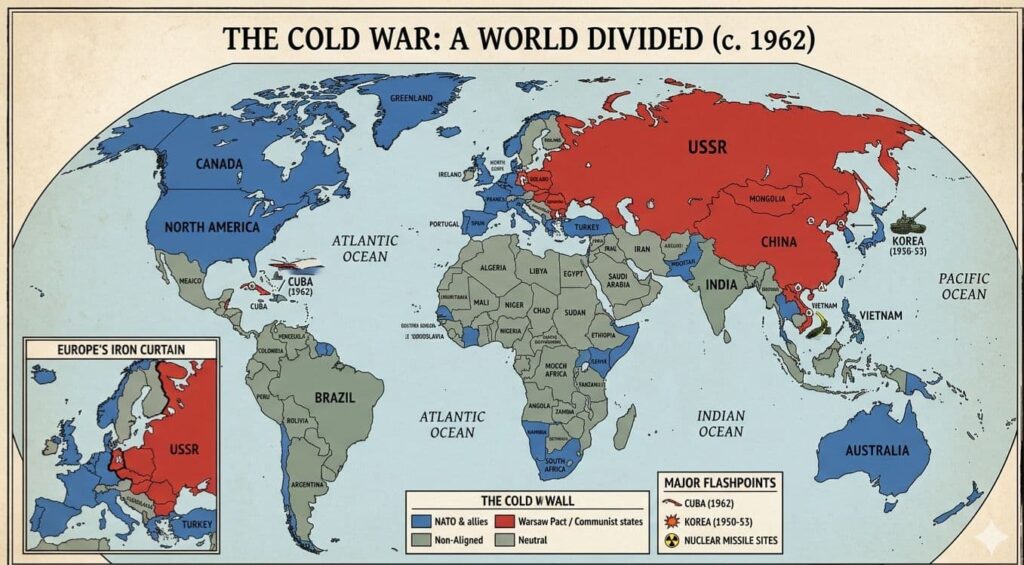
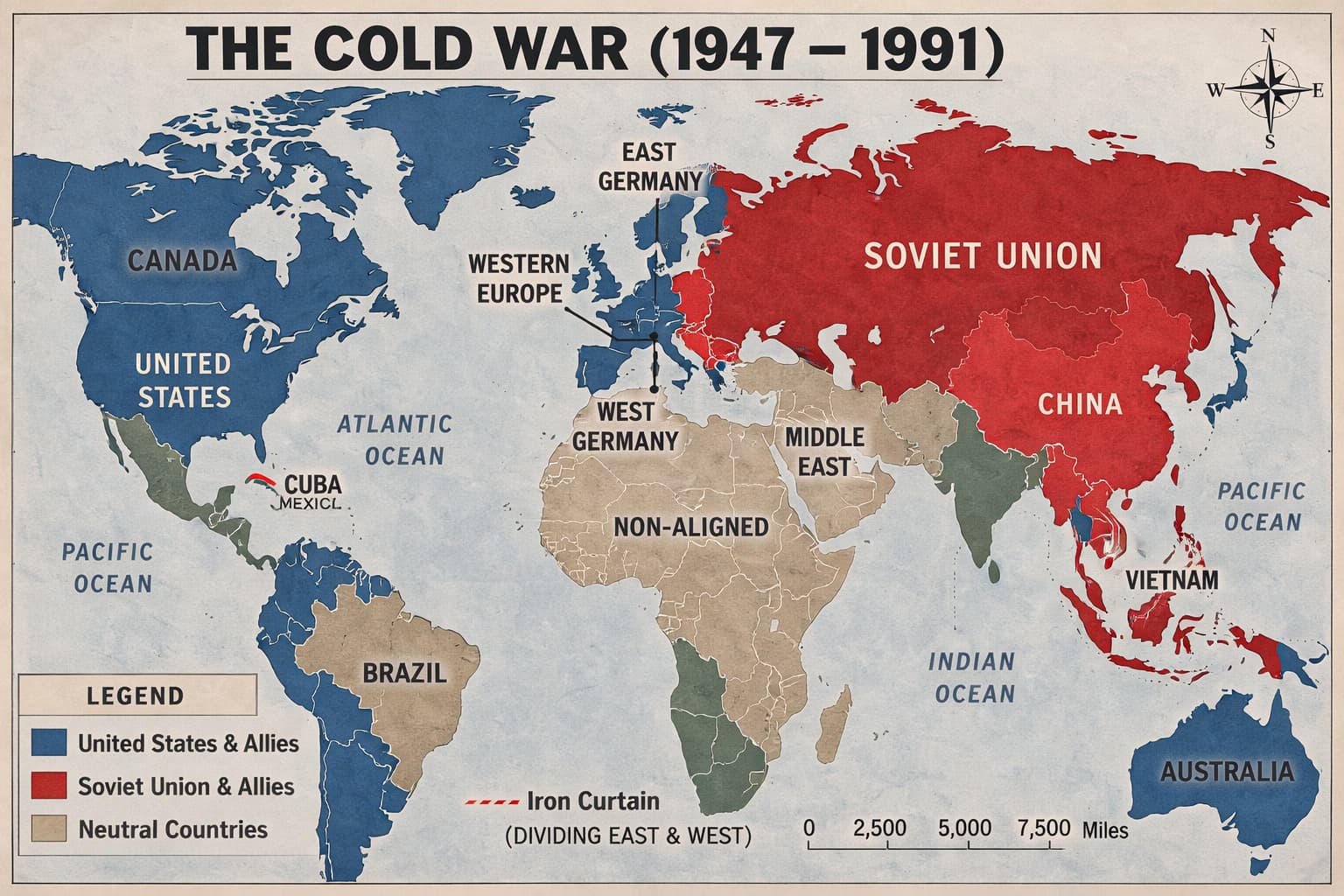
The Cold War was a long period(1945-1991) of political, ideological, military tension and geopolitical tension between the Soviet Union and its satellite states (the Eastern European countries), and the United States with its allies (the Western European countries) after World War II. The Post World War 2, the world got divided into two power blocs dominated by the two super power i.e Soviet Union & United States. The two superpowers were primarily engaged in an ideological war between the capitalist USA and the communist Soviet Union. And it was called a “cold” war because there was no direct large-scale military fighting between the two superpowers, but they competed with each other through political pressure, military alliances, economic aid, propaganda, and proxy wars.
Meaning of Cold War
The Cold War refers to the state of hostility and rivalry between the United States and the Soviet Union and their respective allies. Instead of direct warfare, the conflict was carried out through diplomatic tensions, arms race, ideological conflict, and indirect wars in other countries.
In easy Language:- The Cold War was a time when the United States and the Soviet Union were enemies and competed with each other. They did not fight a direct war against each other. Instead, they showed their rivalry through political disagreements, building powerful weapons, spreading their different ideas, and supporting wars in other countries.
Causes of the Cold War are:-
- Ideological Differences:- The United States supported capitalism and democracy, while the Soviet Union promoted communism. These opposite political systems created mistrust and conflict. And Both countries wanted their system to spread in the world.
- Power Struggle After World War II:- After World War II, both nations emerged as superpowers and wanted to increase their global influence.
- Fear and Suspicion:- Each side suspected the other of trying to expand its political system and dominate the world.
- Formation of Military Alliances:- Such as, The United States formed NATO, while the Soviet Union created the Warsaw Pact, which increased tensions.
- Arms Race – Both countries started building large numbers of nuclear weapons to become stronger than the other.
Major Events of the Cold War
Some important crises and conflicts during the Cold War were:
1. Berlin Blockade (1948–49):-
he Berlin Blockade was one of the first major crises of the Cold War between the United States and the Soviet Union.
- Background:- After World War II, Germany was divided into four zones controlled by the United States, Britain, France, and the Soviet Union. The capital city Berlin, which was located in the Soviet zone, was also divided into four parts.
- Cause of the Blockade:- In 1948, the Western countries introduced a new currency and planned to rebuild West Germany. The Soviet Union opposed this plan because it feared a strong Western-controlled Germany.
- The Blockade:- In June 1948, the Soviet Union blocked all roads, railways, and canals leading to West Berlin. Their aim was to force the Western powers to leave the city by cutting off food, fuel, and supplies.
- The Berlin Airlift:- Instead of leaving, the United States and its allies started the Berlin. Airlift. Thousands of airplanes carried food, coal, and other supplies to the people of West Berlin for almost 11 months.
- End of the Blockade:- In May 1949, the Soviet Union realized the blockade had failed and removed it.
- Significance:-
- It increased tension between the USA and the Soviet Union.
- It showed the determination of Western countries to protect West Berlin.
- It strengthened the division of Germany and intensified the Cold War.
2. Vietnam War (1955–1975):-
The war was fought between North Vietnam and South Vietnam. North Vietnam was supported by the Soviet Union and China, while South Vietnam was supported by the United States and its allies. North Vietnam wanted to unite the country under communism, but the United States tried to stop the spread of communism in Vietnam. The war lasted for about 20 years and caused huge loss of life and destruction.
Result: In 1975, North Vietnam won the war and Vietnam became a unified communist country called Vietnam.
Features of the Cold War
- Formation of military alliances such as NATO and the Warsaw Pact
- Development of nuclear weapons and an arms race
- Space race and technological competition
- Use of propaganda and espionage
- Indirect conflicts in other countries
End of the Cold War
The Cold War ended in 1991 with the collapse of the Soviet Union. After this, the United States emerged as the most powerful country in the world.
Conclusion
The Cold War was one of the most important periods in modern international relations. Although it did not involve direct war between the two superpowers, it created global tension, military competition, and political conflicts for more than four decades.