
Introduction
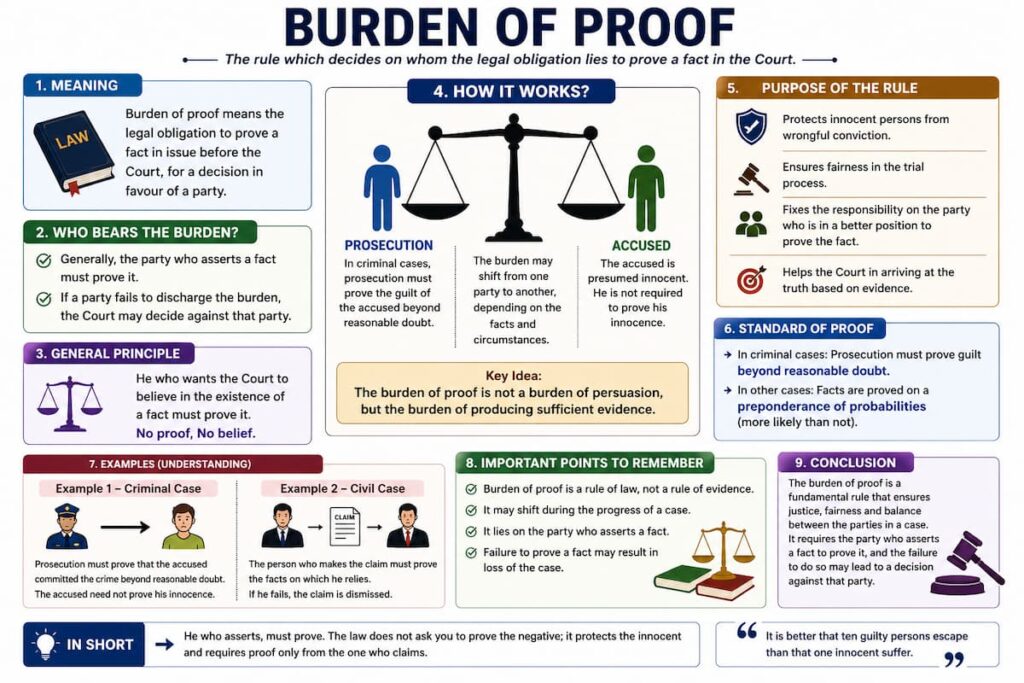
The Burden of Proof means the obligation on a party to prove the facts that he asserts in a case. In simple words : The person who makes a claim must prove it. Burden of Proof is described or define in section 104-114 of chapter 7 BSA.
Meaning of Burden of Proof
The Burden of Proof refers to the legal requirement or responsibility of the parties to establish the facts that assist the court in reaching a decision.
Section – 104 Burden of Proof
- It is a foundation rule.
- The core Principal – “He who asserts must prove”.
- The Law says that if you want a court to give a judgement in your favor based on certain facts, you are the one who must prove those facts exist.
- Who carries the burden – The person who approaches the court ( the plantiff in civil cases or the ‘prosecution’ in criminal cases.
- When does it apply – Whenever a legal right or liability depends on the existence of specific facts.
Section – 105 On whom Burden of Proof lies
- In this Burden of Proof, is shifted.
- The Burden of Proof lies on the party who will lose the case if no evidence is presented by either side.
- In simple terms: ” If there is zero evidence, who will lose?” That party has to provide the proof.
- Court also the default position of the case.
- The burden of proof lies on the party who must move away from the default position of the case. The party has to prove their claim.
- In other words: The burden of proof is on the person who bears the risk in a “no evidence” situation.
Section – 106 Burden of proof as to particular facts
- If a specific fact has to be proved, the burden of proof lies on the person who wants the court to believe in the existence of that fact.
- Exception: If the law specifically states that a particular fact must be proved by a certain person, then that person has to prove it.
- General Rule: “Whoever asserts a fact must prove it”.
- The court will not assume facts on its own unless they are proved with evidence.
Section – 106 In Easy Language
- If you want the court to believe that a specific fact exists, the responsibility (burden) to prove that fact lies on you. The only exception is if the law already says that burden lies on someone else.
- Example:
- ‘A’ is accused of crime in Delhi.
- ‘A’ tells the court, I couldn’t have done it because I was in Mumbai on that day.
- The Burden: Since “being in Mumbai” is a particular fact that ‘A’ wants the court to believe,. ‘A’ must prove it. The Prosecutor only has to prove this crime happened,. They don’t have to prove. ‘A’ wasn’t in Mumbai until A brings it up.
Section – 107 Burden of Proving facts to be proved to make evidence admissible
- If you want to prove a fact, but before proving that fact you also need to prove some other facts, then the burden of proving those preliminary facts lies on you.
- This is called a “condition precedent” – meaning a fact that must be proved first before the main fact can be proved.
- This ensures that evidence is admitted in court only after its admissibility is established.
- When a fact is uniquely known to one person, the law says it is their responsibility to prove it.
- The other side shouldn’t have to struggle to prove something that only you could possibly known.
- Example: ‘A’ wishes to prove, by secondary evidences, the content of a lost document. ‘A’ must prove the document has been lost.
Section – 108 Burden of proving that case of accused comes within exceptions
When a person is accused of an offense, and they take a defense claiming that their case falls under a General Exception (such as those mentioned in BNS Sections 14-30) or any special exception/proviso, the burden of proof lies on the accused.
Key Principles:
- Responsibility of the Accused: It is the duty of the accused to provide proof if they claim the benefit of an exception.
- Court’s Presumption: The court will, by default, presume that no such exception applies until the accused proves its existence.
- Shifting of Burden: While it is generally the duty of the prosecution to prove the crime, if the accused admits that the act occurred but claims they are protected by an exception, the burden of proof shifts to the accused.
- Example: ‘A’ accused of murder, alleges that, by reason of unsoundness of mind, he did not know the nature of threat, the burden of proof is on ‘A’.
Section – 109 Burden of Proving Fact Especially Within Knowledge
When any fact is especially within the knowledge of a specific person:- meaning facts that other people cannot easily know or access – the burden of proving that fact lies upon person. In such cases, the court does not expect the other party to provide proof, as the fact logically resides with the individual in question.
Key Points:
- Practical Convenience: This rule is established for practical convenience in legal proceedings.
- Prevention of Misuse: If a fact is known only to one person, the law requires them to provide the proof. If this were not the case, the law could easily be misused or subverted.
- Example: ‘A’ is charged with travelling on a railway without a ticket. The burden of proving that he had a ticket is on him.
- Note: When any fact especially within the knowledge of any person, the burden proving that fact is upon him.
Section – 110 Burden of Proving Death of Person Know to have been Alive Within Thirty Years
When the question is whether a man is alive or dead, and it is shown that he was alive within thirty years, the burden of proving that he is dead is on the person who affirms it.
Section – 111 Burden of Proving that Person is Alive who has not been Heard for Seven Years
When the question is whether a man is alive or dead, and it is proved that he has not been heard for seven years by those who would naturally have heard of him, if he had been alive. The burden of proving that he is alive is shifted to the person who affirms it.
Section – 112 Burden of Proof as to Relationship in the Cases of Partners, Landlord and Tenant, Principal and Agent.
If it has been proven that certain individuals have been acting as partners, landlord and tenant, or principal and agent, the Court will presume that this relationship continues to exist.
The Burden of Proof
The “Burden of Proof” lies with the person who claims that:
- The relationship has ceased to exist.
- The relationship no longer continues.
Purpose
- Relationship such as partnership, tenancy, or agency are not established merely by verbal claims; they must be proven through the actions of the parties involved.
- Once, it is proven that such a relationship existed, it will be presumed to continue until evidence of its termination is provided.
Section – 113 Burden of Proof as to Ownership
When the question is whether any person is owner of anything of which he is shown to be in possession, the burden of proving that he is not the owner is on the person who affirms that he is not the owner.
- The law states that ‘possession is prima facie evidence of ownership’. This means that the person currently in possession of an object is presumed to be its owner. Anyone wishing to challenge or deny that ownership must provide strong evidence to the contrary.
Section – 114 Proof of good faith is transactions
Section – 114 addresses transaction where one party stands in position of active confidence (trust) in relation to the other.
Key Principles:
- Relationship of Active Confidence: This occurs when two parties have a relationship where one person exerts significant influence or authority over the other.
- Transaction Validity: When a transaction ( such as a sale, gift, or agreement ) takes place within such a relationship, the question of “good faith” (honesty and fairness) often arises.
- Burden of Proof: Under this section, the burden of proof lies on the party who holds the position of active confidence. They must prove that the transaction was made in good faith and was entirely honest.
Purpose of the Law
The law provides protection in relationships where one person is heavily dependent on another. It ensures that the dominant party does not take unfair advantage of the trust placed in them.
Examples of Such Relationships
The following are classic examples of “active confidence” where this rule applies:
- Lawyer – Client
- Doctor – Patient
- Trustee – Beneficiary
- Parent – Child
Conclusion
The doctrine of burden of proof maintains a balance between protecting the innocent and punishing the guilty, making it a cornerstone of a fair judicial system.