
Introduction
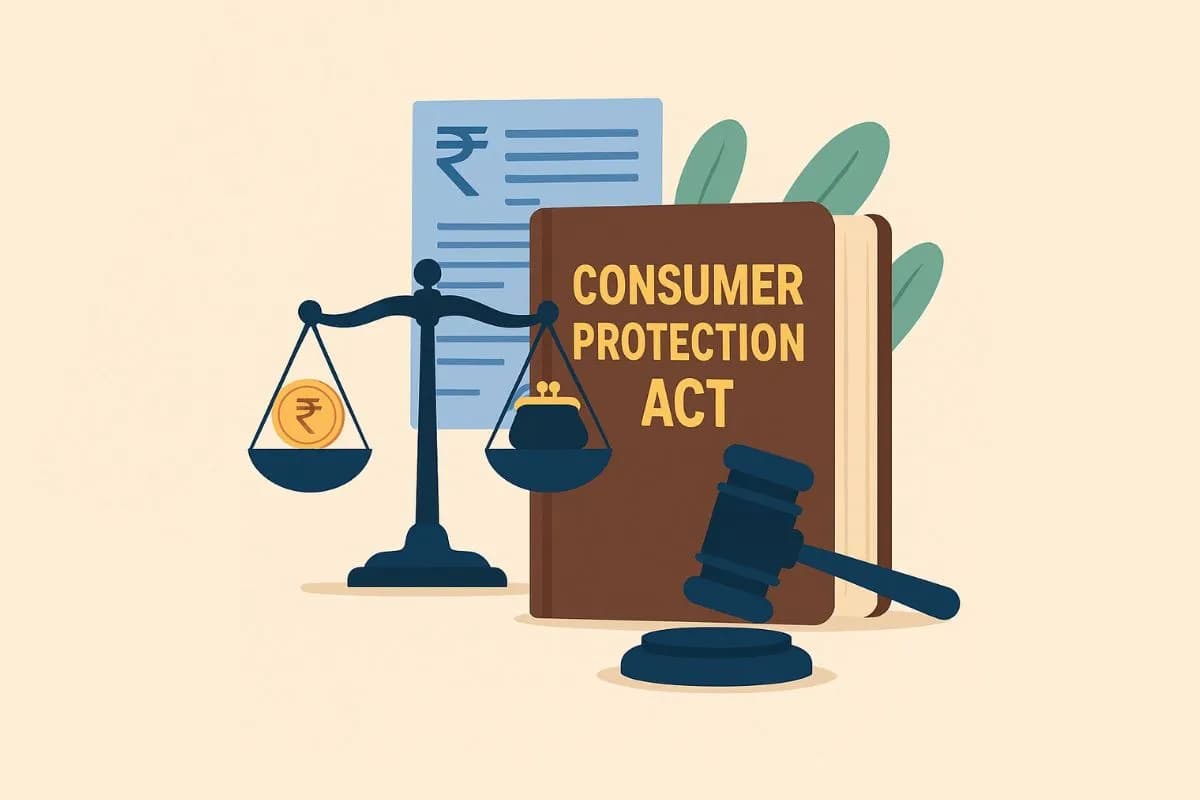
The Consumer Protection Act is a social welfare legislation aimed at providing simple, speedy, and inexpensive justice to the consumers.
The consumer protection was passed in 1986, and later it was amended and replaced by the Consumer Protection Act, 2019 and it was came into force on 20 July 2020. The new Act gave more rights to the consumers and introduces new mechanisms like e-commerce regulation, product liability, and ,mediation.
In era of technology, consumers face many problems such as defective goods, poor quality services, misleading advertisements, unfair trade practices, and exploitation by traders and big companies. To protect consumers from such exploitation, the consumer Protection Act was enacted in India.
History of Consumer Protection Act
The Consumer Protection Act, implemented in 1986, gives easy and fast compensation to consumer grievances. It safeguards and encourages consumers to speak against insufficiency and flaws in goods and services. If traders and manufacturers practice any illegal trade, this act protects their rights as a consumer. The primary motivation of this forum is to bestow aid to both the parties and eliminate lengthy lawsuits.
Important Dates:-
- Lok Sabha on 9th December, 1986
- Rajya Sabha on 10th December, 1986
- Assented by the President of India on 24th December, 1986
- Published in the Gazette of India on 26th December, 1986.
This Act was enacted in the 37th year of the republic of India
and was amended from time to in the following years i.e.
- Amendments in 1993
- Amendments in 2002
- Amendments in 2019 (Latest)

Who is consumer according to Consumer Protection Act 2019
In Section 2(7) of Consumer Protection Act 2019, defines who is consumer and the meaning of consumer. According bare act:- “consumer” means any person who:-
(i) buys any goods for a consideration which has been paid or promised or partly paid and partly promised, or under any system of deferred payment and includes any user of such goods other than the person who buys such goods for consideration paid or promised or partly paid or partly promised, or under any system of deferred payment, when such use is made with the approval of such person, but does not include a person who obtains such goods for resale or for any commercial purpose; Or
(ii) hires or avails of any service for a consideration which has been paid or promised or partly paid and partly promised, or under any system of deferred payment and includes any beneficiary of such service other than the person who hires or avails of the services for consideration paid or promised, or partly paid and partly promised, or under any system of deferred payment, when such services are availed of with the approval of the first mentioned person, but does not include a person who avails of such service for any commercial purpose.
Explanation:- For the purposes of this clause,
(a) the expression “commercial purpose” does not include use by a person of goods bought and used by him exclusively for the purpose of earning his livelihood, by means of self-employment;
(b) the expressions “buys any goods” and “hires or avails any services” includes offline or online transactions through electronic means or by teleshopping or direct selling or multi-level marketing;
In short:- A Consumer is a person who buys goods for consideration or hires or avail services for consideration
It not Includes a person who buys good for resale or commercial purpose (except self-employment for livelihood).
The Rights of Consumer under Consumer Protection Act 2019

Section 2(9) of the consumer protection act explain rights of consumer
- Section 2(9)(i) Right to safety:– Protection against hazardous goods and services
- Section 2(9)(ii) Right to be informed:- Right to know quality, quantity, price, and standard
- Section 2(9)(iii) Right to be assured / Right to Choice :– Access to a variety of goods at competitive prices
- Section 2(9)(iv) Right to be heard:- Consumer interests must be considered
- Section 2(9)(v) Right to Seek Redressal:-Compensation against unfair practices
- Section 2(9)(vi) Right to consumer awareness:- Knowledge about consumer rights
The Responsibilities of the Consumer under Consumer Protection Act 2019 are:-
- Responsibility to be aware – A consumer has to be mindful of the safety and quality of products and services before purchasing.
- Responsibility to think independently– Consumer should be well concerned about what they want and need and therefore make independent choices.
- Responsibility to speak out- Buyer should be fearless to speak out their grievances and tell traders what they exactly want
- Responsibility to be an Ethical Consumer- They should be fair and not engage themselves with any deceptive practice
- Responsibility to complain- It is the consumer’s responsibility to express and file a complaint about their dissatisfaction with goods or services in a sincere and fair manner.
The Objectives of the Consumer Protection Act 2019
- To protect consumers against exploitation
- To provide effective remedies against unfair trade practices
- To promote consumer awareness
- To ensure accountability of manufacturers, sellers, and service providers
- To establish consumer dispute redressal agencies
The Consumer Protection Mechanism are :-
- District Commission (Below 1 crore) :- Handles cases up to a specified monetary limit, located at district level
- State Consumer Disputes Redressal Commission (Below 10 crore) Deals with higher value cases and hears appeals from District commission
- National Consumer Disputes Redressal Commission (NCDRC)(Above 10 Crore) Highest authority and Handles appeals from state commission
The Important Features of Consumer Protection Act 2019
1. Product Liability
Manufacturers, sellers, and service providers are liable for harm caused by defective products.
2. Central Consumer Protection Authority (CCPA)
- Protects consumer rights
- Can order recall of unsafe goods
- Can impose penalties on misleading advertisements
3. Regulation of E-commerce
The Act covers online platforms and protects consumers from digital fraud.
4. Mediation
Provides an alternative dispute resolution mechanism to settle disputes quickly.
5. Misleading Advertisements
Strict punishment for false advertisements, including fines and imprisonment.
Conclusion
The Consumer Protection Act plays a crucial role in safeguarding consumer interests in a rapidly expanding market economy. With the introduction of the Consumer Protection Act, 2019, the law has become more effective, comprehensive, and consumer friendly.
It not only protects consumers from exploitation but also promotes transparency, fairness, and accountability in the marketplace. Thus, the Act is an essential pillar for consumer welfare and economic justice in India.
Note:- If you need a notes Pdf of full consumer protect act 2019, then contact me on Whatsapp 7206174194, Or Join Whatsapp Group By Link: https://chat.whatsapp.com/EXdch0jCmIv96m3WNYiuz8?mode=gi_t



Nice notes 💯 👌
They helped me a lot to score good marks in my exams.